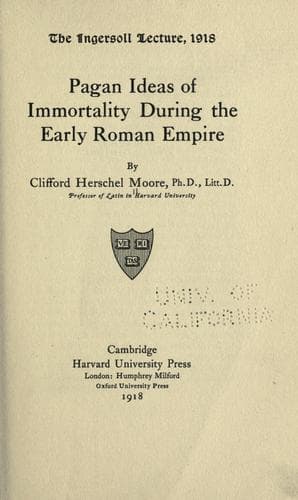
Pagan Ideas of Immortality During the Early Roman EmpireMoore, Clifford Herschel
Religion
Pagan Ideas of Immortality During the Early Roman Empire
Moore, Clifford Herschel
Immortality; Rome -- Religion
It is difficult for us now to appreciate the widespread influence of
these Eleusinian mysteries. They had many branches; at Eleusis they
continued to be celebrated until 396 A.D., when Alaric the Goth
destroyed Demeter’s ancient shrine. Other Greek mysteries also
flourished in the Mediterranean world: those of Samothrace; the
mysteries of Bacchus, whose excesses brought down the displeasure of the
Roman Senate in 186 B.C.; and in later times the mysteries of Hecate or
Diana. All had this in common, that they gave the initiate assurance of
a happy immortality.
Under the Roman Empire the longing for religious satisfaction through
mystic rites and revelations found new and exotic sources of
gratification. Slaves, traders, and finally soldiers from Hellenized
Egypt, Syria, and Asia Minor, carried their gods throughout the
Mediterranean world, and even beyond, to the Atlantic Ocean, to
Hadrian’s Wall in Britain, to the Rhine and Danube, and to the borders
of the African desert. The invasion of the West by these oriental gods
began in 204 B.C., when, in answer to the Roman Senate’s invitation, the
Asiatic Great Mother of the Gods took up her residence in Rome. Many
other divinities came during the succeeding centuries; but three
remained most prominent: the Great Mother of the Gods, whom I have just
mentioned, with her attendant Attis; Egyptian Isis and her associate
divinities, who were worshipped in Rome as early as Cicero’s day; and
the Persian Mithras, whose cult became influential in the West toward
the close of the first century of our era.[29] These religions added to
their exotic charm that spell which great age casts over men’s
imaginations. Osiris, the husband of Isis, had been lord of the dead in
Egypt for more than two thousand years; Attis and the Great Mother
belonged to an immemorial antiquity; while Mithras had his origin in the
remoter East, at a period to which neither Greek nor Roman knowledge
ran. Moreover, Attis and Osiris, like Dionysus and Persephone among the
Greeks, or the Semitic Adonis and Tammuz, were gods who died and lived
again, and who therefore became warrants of man’s immortality. Mithras
belonged to another class of divinities. He was held to be the
benefactor and constant supporter of mankind. According to the sacred
legend, he had himself wrestled with the powers of darkness and had
established civilization on earth, before he ascended to heaven, whence
he was believed to aid his faithful followers in their constant struggle
against the servants of Ahriman, the lord of wickedness.
Public-domain text, read in full here on John Shaqi.
Reviews
Reviews
No reviews yet
Be the first to share your thoughts on this work.
Join the Discussion
Join the discussion
Sign in to leave a comment or review.
Sign InorCreate an account