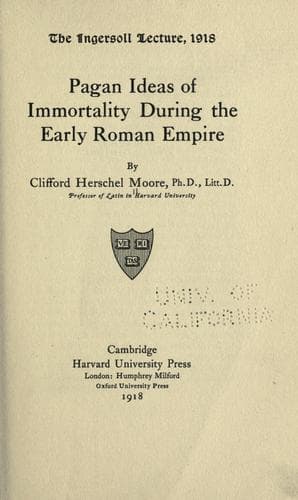
Pagan Ideas of Immortality During the Early Roman EmpireMoore, Clifford Herschel
Religion
Pagan Ideas of Immortality During the Early Roman Empire
Moore, Clifford Herschel
Immortality; Rome -- Religion
Finally we will consider an example of parallelism between pagan and
Christian ideas. It is evident that the Greeks, who made such large use
of successive rebirths, following periods of punishment and
purification below, thought of these repeated lives and deaths as
forming a moral series, so that moral progress, or degeneracy, at one
stage was inseparably connected with both the preceding and the
following stages. To them life here and life in the other world were
indissolubly bound together. This was also as true of Stoicism with its
limited reward for uprightness, as it was of Platonism. The Greek
mysteries, which did not concern themselves with metempsychosis, by the
fifth century before our era likewise made future happiness depend in
part at least on righteousness in this life; the oriental mysteries too
made this existence the condition of the next. In short, we may say that
wherever men believed in any kind of a future existence, they almost
universally held to the common belief that future happiness was to be
the reward of a virtuous life on earth. But this is one of the
fundamental principles of Christianity. Paganism, therefore, was in
accord on this point with its enemy, and thereby favored the propagation
of the new religion; moreover, the superior ethical demands of
Christianity and its humanitarian principles no doubt found a ready
response, especially in enlightened circles.
So we have returned to that which seems to me most important in the
relations of paganism and of early Christianity. In many ways paganism
provided an environment favorable for the spread of the religion which
Jesus founded. The two were at many points irreconcilable, and the
former has not always benefited the latter by its influence; but it is a
grave historical error not to recognize the areas in which the thought
of the two ran parallel. Is the nobler faith the poorer because its
paths were made broad by the pagan in his search after Immortality?
NOTES
1. Eduard Norden, _Aeneis_, _Buch VI_, Leipzig, 1903, is most useful for
its commentary, especially on religious and philosophic matters.
2. W. Warde Fowler, _The Religious Experience of the Roman People_,
Macmillan Co., 1911, pp. 419 ff.
So Dante’s journey through Hell, Purgatory, and Paradise secured his
conversion and salvation, bringing him finally to freedom and to
knowledge. _Paradiso_, XXXI, 85-87 and XXXIII entire.
3. Metempsychosis was the subject of the Ingersoll lecture by Professor
George Foot Moore in 1914. Therefore that theme is not discussed here.
4. Cf. Friedländer, _Roman Life and Manners_, Routledge, London, 1910,
iii, chap. II.
5. On the pre-Hellenic periods, see Schuchhardt, _Schliemann’s
Excavations_, New York, 1891, passim; Lagrange, _La Crète Ancienne_,
Paris, 1908, chap. II; Baikie, _The Sea-Kings of Crete_, London, 1910,
chap. XI.
Public-domain text, read in full here on John Shaqi.
Reviews
Reviews
No reviews yet
Be the first to share your thoughts on this work.
Join the Discussion
Join the discussion
Sign in to leave a comment or review.
Sign InorCreate an account