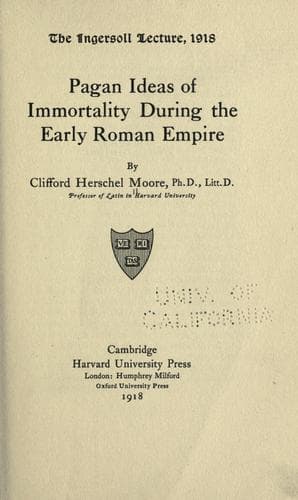
Pagan Ideas of Immortality During the Early Roman Empire — John Shaqi
Pagan Ideas of Immortality During the Early Roman EmpireMoore, Clifford Herschel
Religion
Pagan Ideas of Immortality During the Early Roman Empire
Moore, Clifford Herschel
Immortality; Rome -- Religion
Thus the sojourn of the soul in the world below for the thousand years
which must elapse before it could be born again, was a period of
cleansing from ancient sin. This idea of purification we have already
seen to be as old as the Orphics; it was made an important element by
Plato; and indeed all who held to the doctrine of rebirths regarded the
periods between earthly existences as times of moral punishment and
cleansing. There were certain analogies in Mithraism. Orthodox
Christianity could not adopt the doctrine of metempsychosis, although
some Gnostics found this possible, by rejecting the resurrection of the
body. But beyond question the Greek doctrine of post-mortem purgation
from sin, combining with ideas inherited from the Old Testament, has
been influential in the development of a Christian belief in
purification, especially by fire, in an intermediate state between death
and paradise. The doctrine of purgatory, in somewhat different forms,
has been held by both the Eastern and the Western Churches. Although
this doctrine did not become a definite part of the theology of the
Western Church until the time of Gregory the Great (590-604),
nevertheless traces of it can be found in the earlier Church writers.
Origen held that even the perfect must pass through fire after
death;[39] St. Augustine was less confident, but he thought it not past
belief that imperfect souls might be saved by cleansing flames.[40] The
Western Church, from St. Thomas Aquinas in the thirteenth to Bellarmino
in the sixteenth century held the doctrine that the cleansing fire was
as material as that of any Stoic; but today that view has in large part
been abandoned.[41]
These two illustrations must suffice to suggest the ways in which
Christian thought was influenced by its pagan environment.
Public-domain text, read in full here on John Shaqi.
Reviews
Reviews
No reviews yet
Be the first to share your thoughts on this work.
Join the Discussion
Join the discussion
Sign in to leave a comment or review.
Sign InorCreate an account