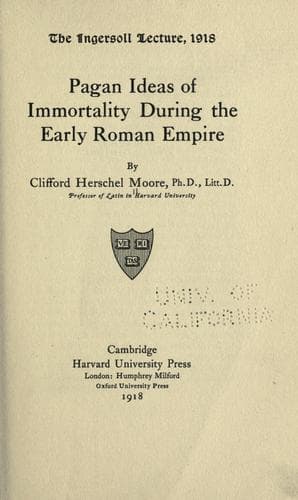
Pagan Ideas of Immortality During the Early Roman EmpireMoore, Clifford Herschel
Religion
Pagan Ideas of Immortality During the Early Roman Empire
Moore, Clifford Herschel
Immortality; Rome -- Religion
The most important single religious document from the Augustan Age is
the sixth book of Virgil’s Aeneid; for although the Aeneid was written
primarily to glorify Roman imperial aims, the sixth book gives full
expression to many philosophic and popular ideas of the other world and
of the future life, which were current among both Greeks and Romans.[1]
It therefore makes a fitting point of departure for our considerations.
In this book, as you will remember, the poet’s hero, having reached
Italian soil at last, is led down to the lower world by the Cumaean
Sybil. This descent to Hades belongs historically to that long series of
apocalyptic writings which begins with the eleventh book of the Odyssey
and closes with Dante’s Divine Comedy. Warde Fowler deserves credit for
clearly pointing out that this visit of Aeneas to the world below is the
final ordeal for him, a mystic initiation, in which he receives
“enlightenment for the toil, peril, and triumph that await him in the
accomplishment of his divine mission.” When the Trojan hero has learned
from his father’s shade the mysteries of life and death, and has been
taught the magnitude of the work which lies before him, and the great
things that are to be, he casts off the timidity which he has hitherto
shown and, strengthened by his experiences, advances to the perfect
accomplishment of his task.[2]
But we are not concerned so much with Virgil’s purpose in writing this
apocalyptic book, as with its contents and with the evidence it gives as
to the current ideas of the other world and the fate of the human soul.
What then does the poet tell us of these great matters? We can hardly do
better than to follow Aeneas and his guide on their journey. This side
of Acheron they meet the souls of those whose bodies are unburied, and
who therefore must tarry a hundred years--the maximum of human
life--before they may be ferried over the river which bounds Hades. When
Charon has set the earthly visitors across that stream, they find
themselves in a place where are gathered spirits of many kinds, who have
not yet been admitted to Tartarus or Elysium: first the souls of infants
and those who met their end by violence--men condemned to death though
innocent, suicides, those who died for love, and warriors--all of whom
must here wait until the span of life allotted them has been completed.
These spirits passed, the mortal visitors come to the walls of Tartarus,
on whose torments Aeneas is not allowed to look, for
“The feet of innocence may never pass
Into this house of sin.”
Public-domain text, read in full here on John Shaqi.
Reviews
Reviews
No reviews yet
Be the first to share your thoughts on this work.
Join the Discussion
Join the discussion
Sign in to leave a comment or review.
Sign InorCreate an account