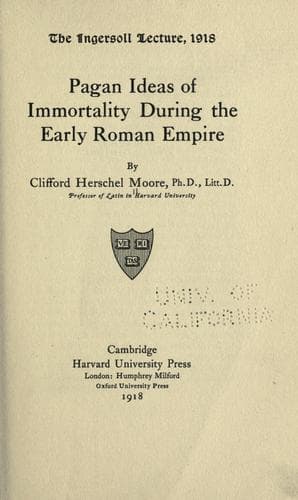
Pagan Ideas of Immortality During the Early Roman EmpireMoore, Clifford Herschel
Religion
Pagan Ideas of Immortality During the Early Roman Empire
Moore, Clifford Herschel
Immortality; Rome -- Religion
But the Sybil, herself taught by Hecate, reveals to him the eternal
punishments there inflicted for monstrous crimes. Then the visitors pass
to Elysium, where dwell the souls of those whose deserts on earth have
won for them a happy lot. Nearby in a green valley, Aeneas finds the
shade of his own father, Anchises, looking eagerly at the souls
which are waiting to be born into the upper world. In answer to
his son’s questions, the heroic shade discloses the doctrine of
rebirths--metempsychosis--with its tenets of penance and of
purification.[3] Finally, to fulfill the poet’s purpose, Anchises’
spirit points out the souls of the heroes who are to come on earth in
due season; the spirits of future Romans pass before Aeneas in long
array; and at the climax he sees the soul of Augustus, that prince who
was destined in the fullness of time to bring back the Golden Age and to
impose peace on the wide world. This prophetic revelation ended, Aeneas
enlightened and strengthened for his task, returns to the upper world.
This book seems at first a strange compound indeed of popular belief,
philosophy, and theology, which is not without its contradictions. On
these, however, we need not pause; but for our present interest we must
ask what are the main ideas on which this apocalypse is based. First of
all, a future life is taken for granted by the poet; otherwise the book
could never have been written. Secondly, we notice that, according to
ancient popular belief, the souls of those who had not received the
proper burial rites, were doomed to wander on this side of Acheron until
a hundred years were completed, and also that souls which were
disembodied by violence or by early death, were destined to live out
their allotted span of earthly existence before they could enter the
inner precincts of Hades. Again the poet represents some few as
suffering eternal torments for their monstrous sins or enjoying immortal
bliss because of their great deserts. And finally, he shows that the
majority of souls must pass through successive lives and deaths, until,
purified from the sin and dross of the body by millennial sojourns in
the world below, and by virtuous lives on earth, they at last find
repose and satisfaction. The popular beliefs which concern details of
the future life we shall leave one side for the moment; let us rather
first observe that Virgil’s ideas as to rewards and punishments in the
next world, as well as his doctrine of successive rebirths and deaths
with their accompanying purifications, rest on a moral basis, so that
the other world is conceived to be a complement of this: life on earth
and life below are opportunities for moral advance without which final
happiness cannot be attained. Whence came these ideas of the future life
and how far were they current in the ancient world of Virgil’s day?
Public-domain text, read in full here on John Shaqi.
Reviews
Reviews
No reviews yet
Be the first to share your thoughts on this work.
Join the Discussion
Join the discussion
Sign in to leave a comment or review.
Sign InorCreate an account