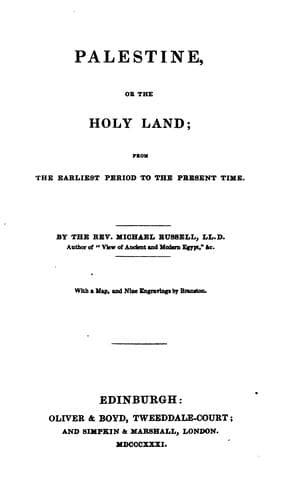
Palestine, or, the Holy Land: From the Earliest Period to the Present TimeRussell, Michael
History
Palestine, or, the Holy Land: From the Earliest Period to the Present Time
Russell, Michael
Palestine -- Description and travel; Palestine -- History
Upon comparing the description given by Maundrell with the accounts of the
latest travellers, we perceive that nearly a century and a half has passed
away without producing any improvement, and that the friars of the present
age are probably not less ignorant or dishonest than their predecessors
five hundred years ago. "They began their disorders by running round the
Holy Sepulchre with all their might and swiftness, crying out as they went
_huia_, which signifies _this is he_, or _this is it_,--an expression by
which they assert the verity of the Christian religion. After they had by
these religious circulations and clamours turned their heads and inflamed
their madness, they began to act the moat antic tricks and postures in a
thousand shapes of distraction. Sometimes they dragged one another along
the floor all round the Sepulchre; sometimes they set one man upright upon
another's shoulders, and in this posture marched round; sometimes they
tumbled round the Sepulchre after the manner of tumblers on the stage. In
a word, nothing can be imagined more rude or extravagant than what was
acted upon this occasion."[85]
"The Greeks first set out in a procession round the Holy Sepulchre, and
immediately at their heels followed the Armenians. In this order they
compassed the Holy Sepulchre thrice, having produced all their gallantry
of standards, streamers, crucifixes, and embroidered habits. Towards the
end of this procession there was a pigeon came fluttering into the cupola
over the Sepulchre, at sight of which there was a greater shout and
clamour than before. This bird, the Latins told us, was purposely let fly
by the Greeks to deceive the people into an opinion that it was a visible
descent of the Holy Ghost. The procession being over, the suffragan of the
Greek patriarch and the principal Armenian bishop approached to the door
of the Sepulchre, and, cutting the string with which it is fastened and
sealed, entered in, shutting the door after them, all the candles and
lamps within having been before extinguished in the presence of the Turks
and other witnesses. The exclamations were doubled as the miracle drew
nearer to its accomplishment; and the people pressed with such vehemence
towards the door of the Sepulchre that it was not in the power of the
Turks to keep them off. The cause of their pressing in this manner is, the
great desire they have to light their candles at the holy flame as soon as
it is first brought out of the Sepulchre, it being esteemed the most
sacred and pure as coming immediately from heaven. The two miracle-mongers
had not been above a minute in the Holy Sepulchre when the glimmering of
the holy fire was seen, or imagined to appear, through some chinks in the
door; and, certainly, Bedlam itself never saw such an unruly transport as
was produced in the mob at this sight.
Public-domain text, read in full here on John Shaqi.
Reviews
Reviews
No reviews yet
Be the first to share your thoughts on this work.
Elsewhere in the archive
Join the Discussion
Join the discussion
Sign in to leave a comment or review.
Sign InorCreate an account