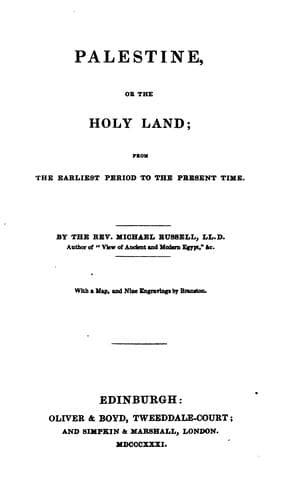
Palestine, or, the Holy Land: From the Earliest Period to the Present TimeRussell, Michael
History
Palestine, or, the Holy Land: From the Earliest Period to the Present Time
Russell, Michael
Palestine -- Description and travel; Palestine -- History
After having satisfied his curiosity in church and convent, the traveller
turns his face southward to Tekoa and Hebron, those remoter villages of
the Holy Land. The former, which was built by Rehoboam, and is
distinguished as the birthplace of Amos the prophet, presents considerable
ruins, and even some remains of architecture. It appears to have stood
upon a hill, which Pococke describes as being about half a mile in length
and a furlong broad. On the north-eastern corner there are fragments of an
old building, supposed to have been a fortress, while about half-way up
the accent there are similar indications of a church now in a state of
complete dilapidation. There is preserved, however, a large font of an
octagon form, composed of red and white marble; as also pieces of broken
pillars consisting of the same material.
Farther towards the south, various manifestations present themselves of
ancient civilization, the traces of which are most distinctly marked by
places of worship and numerous strongholds. The traveler just named
mentions a ruined castle called Creightoun, situated on the side of a
steep hill, and a church dedicated to St. Pantaleone. At a little distance
there is an immense grotto, which is said on one occasion to have
contained 30,000 men; and hence it is conjectured to be one of those
retreats in the fastnesses of Engedi to which David fled from the pursuit
of Saul. About two miles farther, in a south-eastern direction, is the
Mount of Bethulia, near a village of the same name; a position which is
thought to agree with that of Beth-haccerem, specified by Jeremiah as a
proper place for a beacon, where the children of Benjamin were to sound
the trumpet in Tekoa.[107]
There is a tradition that the knights of Jerusalem, during the Holy War,
held this strong post forty years after the capital had fallen. It is a
single hill, and very high; and the top of it appears like a large mount
formed by art, being defended by a double line of fortifications and
several towers, which in a rude state of warfare might be pronounced
almost impregnable. At the foot of an eminence towards the north there are
the remains of a magnificent church as well as of other buildings. On a
slope a little farther west there is a cistern connected with a pond,
which appears to have had an island in it, and probably some structure
suited to the supply of water. These works were also encompassed with a
double wall; and it is said that two aqueducts may still be perceived
terminating in the basin, one from the Sealed Fountain of Solomon, and
another from the hilly district which stretches between Bethlehem and
Tekoa.
Public-domain text, read in full here on John Shaqi.
Reviews
Reviews
No reviews yet
Be the first to share your thoughts on this work.
Elsewhere in the archive
Join the Discussion
Join the discussion
Sign in to leave a comment or review.
Sign InorCreate an account