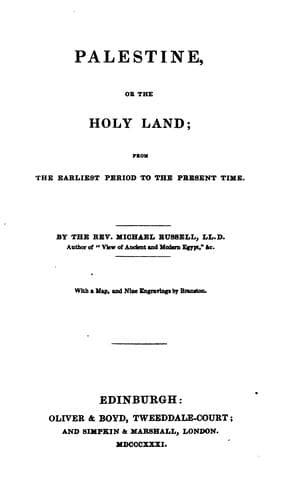
Palestine, or, the Holy Land: From the Earliest Period to the Present Time — John Shaqi
Palestine, or, the Holy Land: From the Earliest Period to the Present TimeRussell, Michael
History
Palestine, or, the Holy Land: From the Earliest Period to the Present Time
Russell, Michael
Palestine -- Description and travel; Palestine -- History
The conversion of Constantine gave a new vigour to these local
reminiscences of the evangelical history. That celebrated ruler wrote to
Macarius, bishop of Jerusalem, to cover the tomb of Jesus Christ with a
magnificent church; while his mother, the Empress Helena, repaired in
person to Palestine, in order to glue a proper efficacy to the zeal which
animated the throne, and to assist in searching for the venerable remains
of the first age of the gospel. To this illustrious female is ascribed the
glory of restoring to religion some of its most valued memorials. Not
satisfied with the splendid temple erected at the Holy Sepulchre, she
ordered two similar edifices to be reared under her own auspices; one over
the manger of the Messiah at Bethlehem, and the other on the Mount of
Olives, to commemorate his ascension into heaven. Chapels, altars, and
houses of prayer gradually marked all the places consecrated by the acts
of the Son of Man; the oral traditions were forthwith committed to
writing, and thereby secured for ever from the treachery of individual
recollection.[4]
These considerations gave great probability to the conjectures of those
pious persons who, in the fourth century of our era, assisted the mother
of Constantine in fixing the locality of holy scenes. From that period
down to the present day, the devotion of the Christian and the avarice of
the Mohammedan have sufficiently secured the remembrance both of the
places and of the events with which they are associated. But no length of
time can wear out the impression of deep reverence and respect which are
excited by an actual examination of those interesting spots that witnessed
the stupendous occurrences recorded in the inspired volume. Or, if there
be in existence any cause which could effectually counteract such natural
and laudable feelings, it is the excessive minuteness of detail and
fanciful description usually found to accompany the exhibition of sacred
relics. The Christian traveller is delighted when he obtains the first
glance of Carmel, of Tabor, of Libanus, and of Olivet; his heart opens to
many touching recollections at the moment when the Jordan, the Lake of
Tiberias, and even the waters of the Dead Sea spread themselves out before
his eyes; but neither his piety nor his belief is strengthened when he has
presented to him a portion of the cross whereon our Saviour was suspended,
the nails that pierced his hands and feet, the linen in which his body was
wrapped, the stone on which his corpse reposed in the sepulchre, as well
as that occupied by the ministering angel on the morning of the
resurrection. The skepticism with which such doubtful remains cannot fail
to be examined is turned into positive disgust when, the guardians of the
grotto at Bethlehem undertake to show the water wherein the infant Messiah
was washed, the milk of the blessed Virgin his mother, the
swaddling-clothes, the manger, and other particulars neither less minute
nor less improbable.
Public-domain text, read in full here on John Shaqi.
Reviews
Reviews
No reviews yet
Be the first to share your thoughts on this work.
Join the Discussion
Join the discussion
Sign in to leave a comment or review.
Sign InorCreate an account