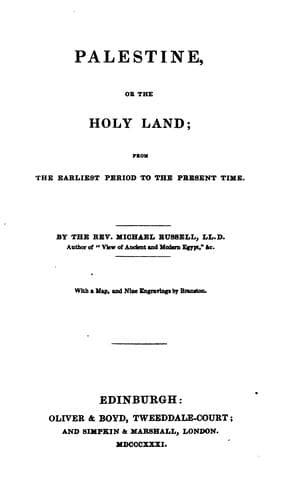
Palestine, or, the Holy Land: From the Earliest Period to the Present TimeRussell, Michael
History
Palestine, or, the Holy Land: From the Earliest Period to the Present Time
Russell, Michael
Palestine -- Description and travel; Palestine -- History
But such abuses, the fruit of many ages of credulity and ignorance, do not
materially diminish the force of the impression produced by scenes which
no art can change, and hardly any description can disguise. The hills
still stand round about Jerusalem, as they stood in the days of David and
of Solomon. The dew falls on Hermon, the cedars grow on Libanus, and
Kishon, that ancient river, draws its stream from Tabor as in the times of
old. The Sea of Galilee still presents the same natural accompaniments,
the fig-tree springs up by the wayside, the sycamore spreads its branches,
and the vines and olives still climb the sides of the mountains. The
desolation which covered the Cities of the Plain is not less striking at
the present hour than when Moses with an inspired pen recorded the
judgment of God; the swellings of Jordan are not less regular in their
rise than when the Hebrews first approached its banks; and he who goes
down from Jerusalem to Jericho still incurs the greatest hazard of falling
among thieves. There is, in fact, in the scenery and manners of Palestine,
a perpetuity that accords well with the everlasting import of its
historical records, and which enables us to identify with the utmost
readiness the local imagery of every great transaction.
The extent of this remarkable country has varied at different times,
according to the nature of the government which it has either enjoyed or
been compelled to acknowledge. When it was first occupied by the
Israelites, the land of Canaan, properly so called, was confined between
the shores of the Mediterranean and the western bank of the Jordan; the
breadth at no part exceeding fifty miles, while the length hardly amounted
to three times that space. At a later period, the arms of David and of his
immediate successor carried the boundaries of the kingdom to the Euphrates
and Orontes on the one hand, an in an opposite direction to the remotest
confines of Edom and Moab. The population, as might be expected, has
undergone a similar variation. It is true that no particular in ancient
history is liable to a better-founded suspicion than the numerical
statements which respect nations and armies; for pride and fear have, in
their turn, contributed not a little to exaggerate, in rival countries,
the amount of the persons capable of taking a share in the field of
battle. Proceeding on the usual grounds of calculation, we must infer,
from the number of warriors whom Moses conducted through the desert, that
the Hebrew people, when they crossed the Jordan, did not fall short of two
millions; while, from facts recorded in the book of Samuel, we may
conclude with greater confidence that the enrolment made under the
direction of Joab must have returned a gross population of five millions
and a half.
Public-domain text, read in full here on John Shaqi.
Reviews
Reviews
No reviews yet
Be the first to share your thoughts on this work.
Join the Discussion
Join the discussion
Sign in to leave a comment or review.
Sign InorCreate an account