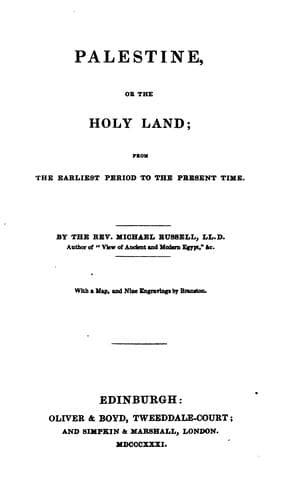
Palestine, or, the Holy Land: From the Earliest Period to the Present TimeRussell, Michael
History
Palestine, or, the Holy Land: From the Earliest Period to the Present Time
Russell, Michael
Palestine -- Description and travel; Palestine -- History
We need not add that such a liquid must be equally salt and bitter. As
might be expected, too, it is found to deposit its salts in copious
incrustations, and to prove a ready agent in all processes of
petrifaction. Clothes, boots, and hats, if dipped in the lake, or
accidentally wetted with its water, are found, when dried, to be covered
with a thick coating of these minerals. Hence, we cannot be surprised to
hear that the Lake Asphaltites does not present any variety of fish.
Mariti asserts that it produces none, and even that those which are
carried into it by the rapidity of the Jordan perish almost immediately
upon being immerged in its acrid waves. A few shell-snails constitute the
sole tenants of its dreary shores, unmixed either with the helix or the
muscle.
It was formerly believed that the approach to Asphaltites was fatal to
birds, and that, like another lake of antiquity, it had the power of
drawing them down from the wing into its poisonous waters. This dream,
propagated by certain visionary travellers, is now completely discredited.
Flocks of swallows may be seen skimming along its surface with the utmost
impunity, while the absence of all other species is easily explained by a
glance at the naked hills and barren plains, which supply no vegetable
food.
The historian Josephus, who measured the Dead Sea, found that in length it
extended about five hundred and eighty stadia, and in breadth one hundred
and fifty,--according to our standard, somewhat more than seventy miles by
nineteen. A recent traveller, to whose unpublished journal we have
repeatedly alluded, remarks that the lake, when he visited it, was sunk or
hollow, and that the banks had been recently under water, being still very
miry and difficult to pass. The shores were covered with dry wood, some of
it good timber, which they say is brought by the Jordan from the country
of the Druses. "The water is pungently salt, like oxymuriate of soda. It
is incredibly buoyant. G---- bathed in it, and when he lay still on his
back or belly, he floated with one-fourth at least of his whole body above
the water. He described the sensation as extraordinary, and more like
lying on a feather-bed than floating on water. On the other hand, he found
the greatest resistance in attempting to move through it: it smarted his
eyes excessively. I put a piece of stick in: it required a good deal of
pressure to make it sink, and when let go it bounded out again like a
blown bladder. The water was clear, and of a yellowish tinge, which might
be from the colour of the stones at bottom, or from the hazy atmosphere.
There were green shrubs down to the water's edge in one place, and nothing
to give an idea of any thing blasting in the neighbourhood of the sea; the
desert character of the soil extending far beyond the possibility of being
affected by its influence."[115]
Public-domain text, read in full here on John Shaqi.
Reviews
Reviews
No reviews yet
Be the first to share your thoughts on this work.
Elsewhere in the archive
Join the Discussion
Join the discussion
Sign in to leave a comment or review.
Sign InorCreate an account