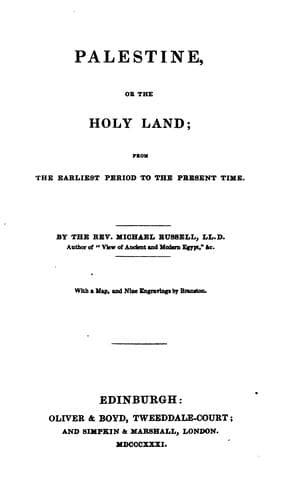
Palestine, or, the Holy Land: From the Earliest Period to the Present TimeRussell, Michael
History
Palestine, or, the Holy Land: From the Earliest Period to the Present Time
Russell, Michael
Palestine -- Description and travel; Palestine -- History
The bitumen supplied by this singular basin affords the means of a
comfortable livelihood to a considerable number of Arabs who frequent its
shores. The Pasha of Damascus, who finds it a valuable article of
commerce, purchases at a small price the fruit of their labours, or
supplies them with food, clothing, and a few ornaments in return for it.
In ancient times it found a ready market in Egypt, where it was used in
large quantities for embalming the dead: it was also occasionally employed
as a substitute for stone, and appeared in the walls of houses and even of
temples.
Associated with the Dead Sea, every reader has heard of the apples of
Sodom, a species of fruit which, extremely beautiful to the eye, is bitter
to the taste, and full of dust. Tacitus, in the fifth book of his history,
alludes to this singular fact, but, as usual, in language so brief and
ambiguous, that no light can be derived from his description, _atra et
inania velut in cinerem vanescunt_. Some travellers, unable to discover
this singular production, have considered it merely as a figure of speech,
depicting the deceitful nature of all vicious enjoyments. Hasselquist
regards it as the production of a small plant called _Solanum melongena_,
a species of nightshade, which is to be found abundantly in the
neighbourhood of Jericho. He admits that the apples are sometimes full of
dust; but this, he maintains, appears only when the fruit is attacked by a
certain insect, which converts the whole of the inside into a kind of
powder, leaving the rind wholly entire, and in possession of its beautiful
colour.
M. Seetzen, again, holds the novel opinion, that this mysterious apple
contains a sort of cotton resembling silk; and, having no pulp or flesh in
the inside, might naturally enough, when sought for as food, be denounced
by the hungry Bedouin as pleasing to the eye and deceitful to the palate.
Chateaubriand has fixed on a shrub different from any of the others. It
grows two or three leagues from the mouth of the Jordan, and is of a
thorny appearance, with small tapering leaves. Its fruit is exactly like
that of the Egyptian lemon, both in size and colour. Before it is ripe it
is filled with a corrosive and saline juice; when dried, it yields a
blackish seed that may be compared to ashes, and which in taste resembles
bitter pepper. There can be little doubt that this is the true apple of
Sodom, which flatters the sight while it mocks the appetite.[116]
Public-domain text, read in full here on John Shaqi.
Reviews
Reviews
No reviews yet
Be the first to share your thoughts on this work.
Elsewhere in the archive
Join the Discussion
Join the discussion
Sign in to leave a comment or review.
Sign InorCreate an account