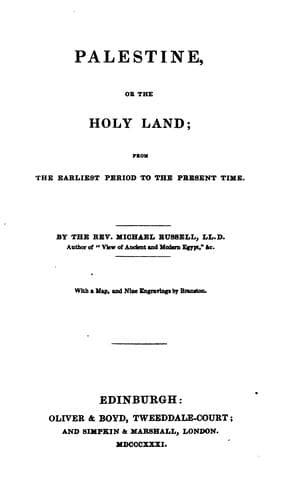
Palestine, or, the Holy Land: From the Earliest Period to the Present TimeRussell, Michael
History
Palestine, or, the Holy Land: From the Earliest Period to the Present Time
Russell, Michael
Palestine -- Description and travel; Palestine -- History
In ascending the western shore, the traveller at length reaches the point
where the Jordan mixes its muddy waters with those of the lake.
Hasselquist, the only modern author who describes the mouth of that
celebrated river, tells us that the plain which extends from thence to
Jericho, a distance of more than three leagues, is, generally speaking,
level, but uncultivated and barren. The soil is a grayish sandy clay, so
loose that the horses often sank up to the knees in it. The whole surface
of the earth is covered with salt in the same manner as on the banks of
the Nile, and would, it is probable, prove no less fruitful were it
irrigated with equal care. The stones on the beach, it is added, were all
quartz, but of various colours; some specimens of which, having a slaty
structure, emitted, when exposed to fire, a strong smell of bitumen,
thereby denoting, perhaps, its volcanic origin.
There is a great want of unanimity among authors in respect to the width
of the Jordan. The Swede whom we have just quoted relates, that opposite
to Jericho it was eight paces over, the banks perpendicular, six feet in
height, the water deep, muddy, warm rather than cold, and much inferior in
quality to that of the Nile. Chateaubriand, again, who measured it in
several places, reports that it was about fifty feet in breadth, and six
feet deep close to the shore,--a discrepancy which must arise from the
period of the year when it was seen by these distinguished writers.[117]
The Old Testament abounds with allusions to the swellings of Jordan; but
at present, whether the current has deepened its channel, or whether the
climate is less moist than in former days, this occurrence is seldom
witnessed,--the river has forgotten its ancient greatness. Maundrell could
discern no sign or probability of such overflowings; for although he was
there on the 30th of March,--the proper season of the inundation,--the
river was running two yards at least under the level of its banks. The
margin of the stream, however, continues as of old to be closely covered
with a natural forest of tamarisk, willows, oleanders, and similar trees,
and to afford a retreat to several species of wild beasts. Hence the fine
metaphor of the prophet Jeremiah, who assimilates an enraged enemy to a
lion coming up "from the swellings of Jordan," driven from his lair by the
annual flood, and compelled to seek shelter in the surrounding desert.
Public-domain text, read in full here on John Shaqi.
Reviews
Reviews
No reviews yet
Be the first to share your thoughts on this work.
Elsewhere in the archive
Join the Discussion
Join the discussion
Sign in to leave a comment or review.
Sign InorCreate an account