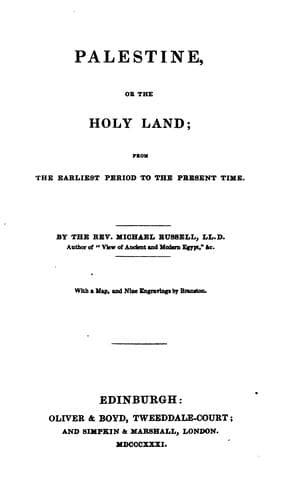
Palestine, or, the Holy Land: From the Earliest Period to the Present TimeRussell, Michael
History
Palestine, or, the Holy Land: From the Earliest Period to the Present Time
Russell, Michael
Palestine -- Description and travel; Palestine -- History
Jericho, which is at present a miserable village inhabited by half-naked
Arabs, derives all its importance from history. It was the first city
which the Israelites reduced upon entering the Holy Land. Five hundred and
thirty years afterward it was rebuilt by Heliel of Bethel, who succeeded
in restoring its population, its splendour, and its commerce; in which
flourishing condition it appears to have continued during several
centuries. Mark Antony, in the pride of power, presented to Cleopatra the
whole territory of Jericho. Vespasian, in the course of the sanguinary war
which he prosecuted in Judea, sacked its walls, and put its inhabitants to
the sword. Re-established by Adrian in the 138th year of our faith, it was
doomed at no distant era to experience new disasters. It was again
repaired by the Christians, who made it the seat of a bishop; but in the
twelfth century it was overthrown by the infidels, and has not since
emerged from its ruins. Of all its magnificent buildings there remain only
the part of one tower, supposed to be the dwelling of Zaccheus the
publican, and a quantity of rubbish, which is understood to mark the line
of its ancient walls.
Mr. Buckingham saw reason to believe that the true site of Jericho, as
described by Josephus, was at a greater distance from the river than the
village of Rahhah, commonly supposed to represent the City of Palms.
Descending from the mountains which bound the valley on the western side,
he observed the ruins of a large settlement, covering at least a square
mile, whence, as well as from the remains of aqueducts and fountains, he
was led to conclude that it must have been a place of considerable
consequence. Some of the more striking objects among the wrecks of this
ancient city were large tumuli, evidently the work of art, and resembling
those of the Greek and Trojan heroes on the plains of Ilium. There were,
besides, portions of ruined buildings, shafts of columns, and a capital of
the Corinthian order; tokens not at all ambiguous of former grandeur and
of civilized life.
Public-domain text, read in full here on John Shaqi.
Reviews
Reviews
No reviews yet
Be the first to share your thoughts on this work.
Elsewhere in the archive
Join the Discussion
Join the discussion
Sign in to leave a comment or review.
Sign InorCreate an account