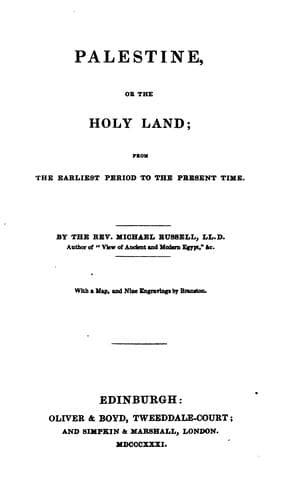
Palestine, or, the Holy Land: From the Earliest Period to the Present TimeRussell, Michael
History
Palestine, or, the Holy Land: From the Earliest Period to the Present Time
Russell, Michael
Palestine -- Description and travel; Palestine -- History
_Description of the Country Northward of Jerusalem_.
Grotto of Jeremiah; Sepulchres of the Kings; Singular Doors; Village of
Leban; Jacob's Well; Valley of Shechem; Nablous; Samaritans; Sebaste;
Jennin; Gilead; Geraza, or Djerash; Description of Ruins; Gergasha of the
Hebrews; Rich Scenery of Gilead; River Jabbok; Souf; Ruins of Gamala;
Magnificent Theatre; Gadara; Capernaum, or Talhewm; Sea of Galilee;
Bethsaida and Chorazin; Tarrachea; Sumuk; Tiberias; Description of modern
Town; House of Peter; Baths; University; Mount Tor, or Tabor; Description
by Pococke, Maundrell, Burckhardt, and Doubdan; View from the Top; Great
Plain; Nazareth; Church of Annunciation; Workshop of Joseph; Mount of
Precipitation; Table of Christ; Cana, or Kefer Kenna; Waterpots of Stone;
Saphet, or Szaffad; University; French; Sidney Smith; Dan; Sepphoris;
Church of St. Anne; Description by Dr. Clarke; Vale of Zabulon; Vicinity
of Acre.
Upon leaving the northern gate of Jerusalem, on the road which leads to
Damascus, there is seen a large grotto much venerated by Christians,
Turks, and Jews, said to have been for some time the residence, or rather
the prison, of the prophet Jeremiah. The bed of the holy man is shown, in
the form of a rocky shelf, about eight feet from the ground; and the spot
is likewise pointed out on which he is understood to have written his book
of Lamentations. In the days of Maundrell, this excavation was occupied by
a college of dervises.
We have already alluded to the Sepulchres of the Kings as very singular
remains of ancient architecture, and standing at a little distance from
the city. There still prevails some obscurity in regard to the origin and
intention of these places of burial, occasioned chiefly by the fact
recorded in Holy Scripture, that the tombs of the kings of Judah were on
Mount Zion. Pococke held the opinion, that they derived their name from
Helena, the queen of Adiabene, whose body was deposited in a cave outside
the northern wall of Jerusalem; a conclusion which derives some
countenance from the language of Josephus, and has been adopted by Dr.
Clarke. M. de Chateaubriand, on the contrary, supposes these grottoes to
have been appropriated to the family of Herod; and in support of his views
quotes a passage from the Jewish historian, who, speaking of the wall
which Titus erected to press Jerusalem still more closely than before,
says, that "this wall, returning towards the north, enclosed the sepulchre
of Herod." Now this, adds the Frenchman, is the situation of the royal
caverns.
Public-domain text, read in full here on John Shaqi.
Reviews
Reviews
No reviews yet
Be the first to share your thoughts on this work.
Elsewhere in the archive
Join the Discussion
Join the discussion
Sign in to leave a comment or review.
Sign InorCreate an account