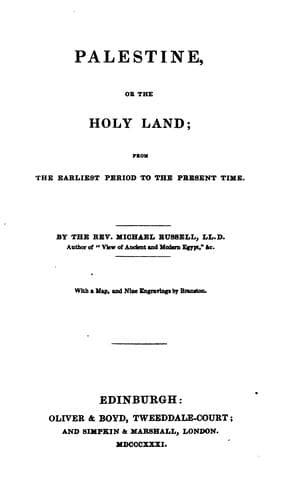
Palestine, or, the Holy Land: From the Earliest Period to the Present TimeRussell, Michael
History
Palestine, or, the Holy Land: From the Earliest Period to the Present Time
Russell, Michael
Palestine -- Description and travel; Palestine -- History
But whoever was buried here, this is certain, to use the words of the
accurate Maundrell, that the place itself discovers so great an expense
both of labour and treasure, that we may well suppose it to have been the
work of kings. You approach it on the east side through an entrance cut
out of the rock, which admits you into an open court of about forty paces
square. On the south side is a portico nine paces long and four broad,
likewise hewn out of the natural rock, and having an architrave running
along its front adorned with sculpture of fruits and flowers. The passage
into the sepulchre is now so greatly obstructed with stones and rubbish
that it is no easy matter to creep through; but having overcome this
difficulty you arrive at a large room, seven or eight yards square,
excavated in the solid body of the hill. It sides and ceiling are so
exactly square, and its angles so just, that no architect could form a
more regular apartment; while the whole is so firm and entire, that it
resembles a chamber hollowed out of one piece of marble. From this room
you pass into six others, all of the same construction; the two innermost
being somewhat deeper than the rest, and are descended to by a certain
number of steps.
In every one of these, except the first, were coffins of stone placed in
niches formed in the sides of the chamber. They had at first been covered
with handsome lids; but the most of them have been long broken to pieces,
and either scattered about the apartment, or entirely removed. One of
white marble was observed by Dr. Clarke, adorned all over with the richest
and most beautiful carving; though, like all the other sculptured work in
the tombs, it represented nothing of the human figure, nor of any living
thing, but consisted entirely of foliage and flowers, and principally of
the leaves and branches of the vine. The receptacles for the dead bodies
are not much larger than European coffins; but, having the more regular
form of parallelograms, they thereby differ from the usual appearance
presented in the sepulchral crypts of the country, where the soros is of
considerable size, and generally resembles a cistern. The taste manifested
in the interior of these chambers seems also to denote a later period in
the history of the arts; the skill and neatness visible in the carving is
admirable, and there is much of ornament displayed in several parts of the
work.
Public-domain text, read in full here on John Shaqi.
Reviews
Reviews
No reviews yet
Be the first to share your thoughts on this work.
Elsewhere in the archive
Join the Discussion
Join the discussion
Sign in to leave a comment or review.
Sign InorCreate an account