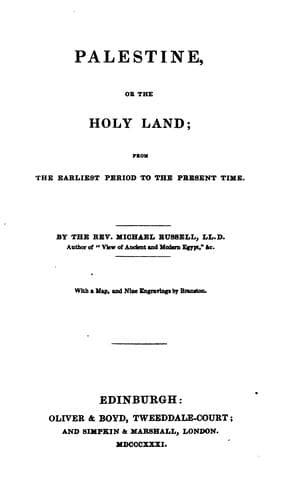
Palestine, or, the Holy Land: From the Earliest Period to the Present TimeRussell, Michael
History
Palestine, or, the Holy Land: From the Earliest Period to the Present Time
Russell, Michael
Palestine -- Description and travel; Palestine -- History
But the most surprising thing belonging to these subterranean chambers is
their doors; of which, when Mr. Maundrell visited Jerusalem, there was
still one remaining. "It consisted," says he, "of a plank of stone of
about six inches in thickness, and in its other dimensions equalling the
size of an ordinary door, or somewhat less. It was carved in such a manner
as to resemble a piece of wainscot: the stone of which it was made was
visibly of the same kind with the whole rock; and it turned upon two
hinges in the nature of axles. These hinges were of the same entire piece
of stone with the door, and were contained in two holes of the immoveable
rock, one at the top and another at the bottom."[128]
We are informed by Dr. Clarke, that the same sort of contrivance is to be
found among the sepulchres at Telmessus; and, moreover, that the ancients
had the art of being able to close these doors in such a manner that no
one could have access to the tomb who was not acquainted with the secret
method of opening them, unless by violating the abode of the dead, and
forcing a passage through the stone. This has been done in several
instances at the place just named; but the doors, though broken, still
remain closed with their hinges unimpaired.[129]
In pursuing the road to Nablous, the ancient Shechem, the first village
which meets the eye of the traveller is Beer, so named from the well or
spring where the wayfaring man stops to quench his thirst. The
inhabitants, who appear to be chiefly Arabs, are in the greatest poverty,
oppressed and alarmed by the incessant demands of their Turkish rulers. It
is the Michmash of Scripture, celebrated as the place whither Jotham fled
from the anger of his brother Abimelech. It presents, too, the remains of
an old church, created, as tradition reports, by the pious Helena, on tho
spot where the Virgin sat down to bewail the absence of her son, who had
tarried behind in Jerusalem to commune with the doctors in the Temple.
Beyond this interesting hamlet, at the distance of about four hours, is
Leban, called Lebonah in the Bible, a village situated on the eastern side
of a delicious vale. The road between these two places is carried through
a wild and very hilly country, destitute of trees or other marks of
cultivation, and rendered almost totally unproductive by the barbarism of
the government. In a narrow dell, formed by two lofty precipices, are the
ruins of a monastery, being in the neighborhood of that mystic Bethel
where Jacob enjoyed his vision of heavenly things, and had his stony couch
made easy by the beautiful picture of ministering angels ascending and
descending from the presence of the Eternal.
Public-domain text, read in full here on John Shaqi.
Reviews
Reviews
No reviews yet
Be the first to share your thoughts on this work.
Elsewhere in the archive
Join the Discussion
Join the discussion
Sign in to leave a comment or review.
Sign InorCreate an account