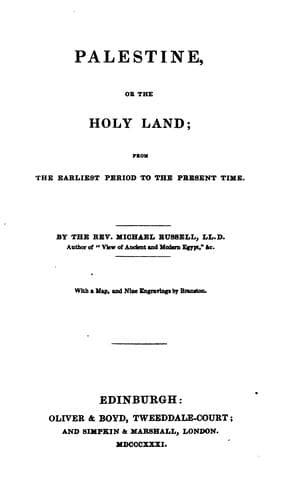
Palestine, or, the Holy Land: From the Earliest Period to the Present TimeRussell, Michael
History
Palestine, or, the Holy Land: From the Earliest Period to the Present Time
Russell, Michael
Palestine -- Description and travel; Palestine -- History
The next object of interest is connected with the name of the same
patriarch. It is Jacob's Well,--the scene of the memorable conference
between our Saviour and the woman of Samaria. Such a locality was too
important to be omitted by Helena while selecting sites for Christian
churches. Over it, accordingly, was erected a large edifice; of which,
however, the "voracity of time, aided by the Turks," has left nothing but
a few foundations remaining. Maundrell tells us that "the well is covered
at present with an old stone vault, into which you are let down through a
very straight hole; and then removing a broad flat stone you discover the
mouth of the well itself. It is dug in a firm rock, and extends about
three yards in diameter and thirty-five in depth; five of which we found
full of water. This confutes a story commonly told to travellers who do
not take the pains to examine the well, namely, that it is dry all the
year round except on the anniversary of that day on which our Blessed Lord
sat upon it; but then bubbles up with abundance of water."[130]
At this point the traveller enters the narrow valley of Shechem, or
Sychar, as it is termed in the New Testament, overhung on either side by
the two mountains Gerizim and Ebal. These eminences, it is well known,
have obtained much celebrity as the theatre on which was pronounced the
sanction of the Divine law--the blessings which attend obedience, and the
curses which follow the violation of the heavenly statutes. "And it shall
come to pass, when the Lord thy God hath brought thee in unto the land
whither thou goest to possess it, that thou shalt put the blessing upon
Mount Gerizim, and the curse upon Mount Ebal. Are they not on the other
side Jordan, by the way where the sun goeth down, in the land of the
Canaanites, which dwell in the champaign over against Gilgal, beside the
plains of Moreh?"[131]
Public-domain text, read in full here on John Shaqi.
Reviews
Reviews
No reviews yet
Be the first to share your thoughts on this work.
Elsewhere in the archive
Join the Discussion
Join the discussion
Sign in to leave a comment or review.
Sign InorCreate an account