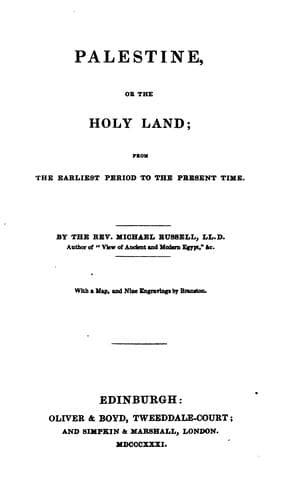
Palestine, or, the Holy Land: From the Earliest Period to the Present TimeRussell, Michael
History
Palestine, or, the Holy Land: From the Earliest Period to the Present Time
Russell, Michael
Palestine -- Description and travel; Palestine -- History
Even in our day, some remains are to be found of the walls which the
ancient cultivators built to support the soil on the declivities of the
mountains; the form of the cisterns in which they collected the
rain-water; and traces of the canals by which this water was distributed
over the fields. These labours necessarily created a prodigious fertility
under an ardent sun, where a little moisture was the only requisite to
revive the vegetable world. The accounts given by native writers
respecting the productive qualities of Judea are not in any degree opposed
even by the present aspect of the country. The case is exactly the same
with some islands in the Archipelago; a tract, from which a hundred
individuals can hardly draw a scanty subsistence, formerly maintained
thousands in affluence. Moses might justly say that Canaan abounded in
milk and honey. The flocks of the Arabs still find in it a luxuriant
pasture, while the bees deposite in the holes of the rocks their delicious
stores, which are sometimes seen flowing down the surface.
The opinions just stated in regard to the fertility of ancient Palestine
receive an ample confirmation from the Roman historians, to whom, as a
part of their extensive empire, it was intimately known. Tacitus,
especially, in language which he appears to have formed for his own use,
describes its natural qualities with the utmost precision, and, as is his
manner, suggests rather than specifies a catalogue of productions, the
accuracy of which is verified by the latest observations. The soil is
rich, and the atmosphere dry; the country yields all the fruits which are
known in Italy, besides balm and dates.[6]
But it has never been denied that there is a remarkable difference between
the two sides of the ridge which forms the central chain of Judea. On the
western acclivity, the soil rises from the sea towards the elevated ground
in four distinct terraces, which are covered with an unfading verdure. The
shore is lined with mastic-trees; palms, and prickly pears. Higher up, the
vines, the olives, and the sycamores amply repay the labour of the
cultivator; natural groves arise, consisting of evergreen oaks, cypresses,
andrachnés, and turpentines. The face of the earth is embellished with the
rosemary, the cytisus, and the hyacinth. In a word, the vegetation of
these mountains has been compared to that of Crete. European visitors have
dined under the shade of a lemon-tree as large as one of our strongest
oaks, and have seen sycamores, the foliage of which was sufficient to
cover thirty persons along with their horses and camels.
Public-domain text, read in full here on John Shaqi.
Reviews
Reviews
No reviews yet
Be the first to share your thoughts on this work.
Join the Discussion
Join the discussion
Sign in to leave a comment or review.
Sign InorCreate an account