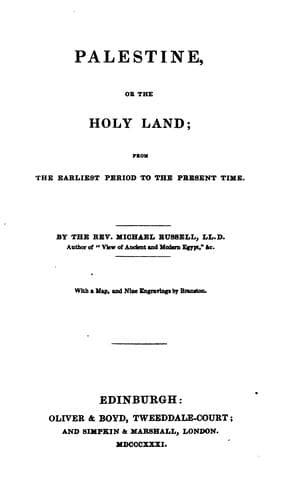
Palestine, or, the Holy Land: From the Earliest Period to the Present Time — John Shaqi
Palestine, or, the Holy Land: From the Earliest Period to the Present TimeRussell, Michael
History
Palestine, or, the Holy Land: From the Earliest Period to the Present Time
Russell, Michael
Palestine -- Description and travel; Palestine -- History
The present aspect of Palestine, under an administration where every thing
decays and nothing is renewed, can afford no just criterion of the
accuracy of such statements. Hasty observers have indeed pronounced that a
hilly country destitute of great rivers, could not, even under the most
skilful management, supply food for so many mouths. But this precipitate
conclusion has been vigorously combated by the most competent judges, who
have taken pains to estimate the produce of a soil under the fertilizing
influence of a sun which may be regarded as almost tropical, and of a
well-regulated irrigation which the Syrians knew how to practise with the
greatest success. Canaan, it must be admitted, could not be compared to
Egypt in respect to corn. There is no Nile to scatter the riches of an
inexhaustible fecundity over its valleys and plains. Still it was not
without reason that Moses described it as "a good land, a land of brooks
of water, of fountains, and depths that spring out of valleys and hills; a
land of wheat, and barley, and vines, and fig-trees, and pomegranates; a
land of oil-olive and honey; a land wherein thou shalt eat bread without
scarceness, thou shalt not lack any thing in it; a land whose stones are
iron, and out of whose hills thou mayst dig brass."[5]
The reports of the latest travellers confirm the accuracy of the picture
drawn by this divine legislator. Near Jericho the wild olives continue to
bear berries of a large size, which give the finest oil. In places
subjected to irrigation, the same field, after a crop of wheat in May,
produces pulse in autumn. Several of the trees are continually bearing
flowers and fruit at the same time, in all their stages. The mulberry,
planted in straight rows in the open field, is festooned by the tendrils
of the vine. If this vegetation seems to languish or become extinct during
the extreme heats,--if in the mountains it is at all seasons detached and
interrupted,--such exceptions to the general luxuriance are not to be
ascribed simply to the general character of all hot climates, but also to
the state of barbarism in which the great mass of the present population
is immersed.
Public-domain text, read in full here on John Shaqi.
Reviews
Reviews
No reviews yet
Be the first to share your thoughts on this work.
Join the Discussion
Join the discussion
Sign in to leave a comment or review.
Sign InorCreate an account