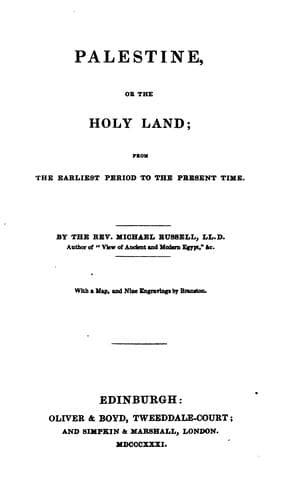
Palestine, or, the Holy Land: From the Earliest Period to the Present Time — John Shaqi
Palestine, or, the Holy Land: From the Earliest Period to the Present TimeRussell, Michael
History
Palestine, or, the Holy Land: From the Earliest Period to the Present Time
Russell, Michael
Palestine -- Description and travel; Palestine -- History
Palestine, agreeably to the modern acceptation of the term, embraces the
country of the ancient Philistines, the most formidable enemies of the
Hebrew tribes prior to the reign of David. Besides Gaza, the chief town,
we recognise the celebrated port of Jaffa or Yaffa, corresponding to
the Joppa mentioned in the Sacred Writings. Repeatedly fortified and
dismantled, this famous harbour has presented such a variety of
appearances, that the description given of it in one age has hardly
ever been found to apply to its condition in the very next.
Bethlehem, where the divine Messias was born, is a large village inhabited
promiscuously by Christians and Mussulmans, who agree in nothing but their
detestation of the tyranny by which they are both unmercifully oppressed.
The locality of the sacred manger is occupied by an elegant church,
ornamented by the pious offerings of all the nations of Europe. It is
not our intention to enter into a more minute discussion of those old
traditions, by which the particular places rendered sacred by the
Redeemer's presence are still marked out for the veneration of the
faithful. They present much vagueness, mingled with no small portion of
unquestionable truth. At all events, we must not regard them in the same
light in which we are compelled to view the story that claims for Hebron
the possession of Abraham's tomb, and attracts on this account the
veneration both of Nazarenes and Moslems.
To the north-east of Jerusalem, in the large and fertile valley called
El-Gaur, and watered by the Jordan, we find the village of Rah, the
ancient Jericho, denominated by Moses the City of Palms. This is a name
to which it is still entitled; but the groves of opobalsamum, or balm
of Moses, have long disappeared; nor is the neighbourhood any longer
adorned with those singular flowers known among the Crusaders by the
familiar appellation of Jericho roses. A little farther south two rough
and barren chains of hills encompass with their dark steeps a long basin
formed in a clay soil mixed with bitumen and rock-salt. The water
contained in this hollow is impregnated with a solution of different
saline substances, having lime, magnesia, and soda for their base,
partially neutralized with muriatic and sulfuric acid. The salt which it
yields by evaporation is about one-fourth, of its weight. The bituminous
matter rises from time to time from the bottom of the lake, floats on
the surface, and is thrown out on the shores, where it is gathered for
various economical purposes. It is to be regretted that this inland sea
has not yet been examined with the attention which it deserves. We
are told, indeed, by the greater number of those who have visited it,
that neither fish nor shells are to be found in its waters; that an
unwholesome vapour is constantly emitted from its bosom; and that its
banks, hideous and desolate in the extreme, are never cheered by the
note of any bird. But it is admitted by the same travellers, that
Public-domain text, read in full here on John Shaqi.
Reviews
Reviews
No reviews yet
Be the first to share your thoughts on this work.
Join the Discussion
Join the discussion
Sign in to leave a comment or review.
Sign InorCreate an account