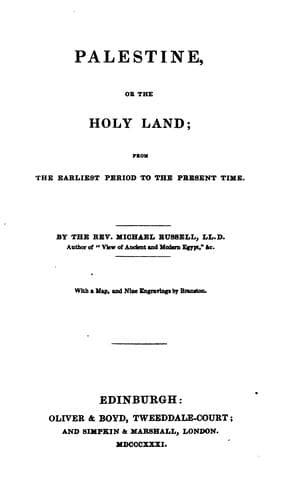
Palestine, or, the Holy Land: From the Earliest Period to the Present TimeRussell, Michael
History
Palestine, or, the Holy Land: From the Earliest Period to the Present Time
Russell, Michael
Palestine -- Description and travel; Palestine -- History
Galilee, says a learned writer, would be a paradise were it inhabited by
an industrious people under an enlightened government. Vine stocks are to
be seen here a foot and a half in diameter, forming, by their twining
branches, vast arches and extensive ceilings of verdure. A cluster of
grapes, two or three feet in length, will give an abundant supper to a
whole family. The plains of Esdraelon are occupied by Arab tribes, around
whose brown tents the sheep and lambs gambol to the sound of the reed,
which at nightfall calls them home.[10]
For some years this fine country has groaned and bled under the malignant
genius of Turkish despotism. The fields are left without cultivation, and
the towns and villages are reduced to beggary; but the latest accounts
from the holy Land encourage us to entertain the hope, that a milder
administration will soon change the aspect of affairs, and bestow upon the
Syrian provinces at large some of the benefits which the more liberal
policy of Mohammed Ali has conferred upon the pashalic of Egypt.
Proceeding from Galilee towards the metropolis, we enter the land of
Samaria, comprehending the modern districts of Areta and Nablous. In the
former we find the remains of Cesarea; and on the Gulf of St. Jean d'Acre
stands the town of Caypha, where there is a good anchorage for ships. On
the south-west of this gulf extends a chain of mountains, which terminates
in the promontory of Carmel, a name famous in the annals of our religion.
There Elijah proved by miracles the divinity of his mission; and there, in
the middle ages of the church, resided thousands of Christian devotees,
who sought a refuge for their piety in the caves of the rocks. Then the
mountain was wholly covered with chapels and gardens, whereas at the
present day nothing is to be seen but scattered ruins amid forests of oak
and olives, the bright verdure being only relieved by the whiteness of the
calcareous cliffs over which they are suspended. The heights of Carmel, it
has been frequently remarked, enjoy a pure and enlivening atmosphere,
while the lower grounds of Samaria and Galileo are obscured by the densest
fogs.
The Shechem of the Scriptures, successively known by the names of Neapolis
and Nablous, still contains a considerable population, although its
dwellings are mean and its inhabitants poor. The ruins of Samaria itself
are now covered with orchards; and the people of the district, who have
forgotten their native dialect, as well perhaps as their angry disputes
with the Jews, continue to worship the Deity on the verdant slopes of
Gerizim.
Public-domain text, read in full here on John Shaqi.
Reviews
Reviews
No reviews yet
Be the first to share your thoughts on this work.
Join the Discussion
Join the discussion
Sign in to leave a comment or review.
Sign InorCreate an account