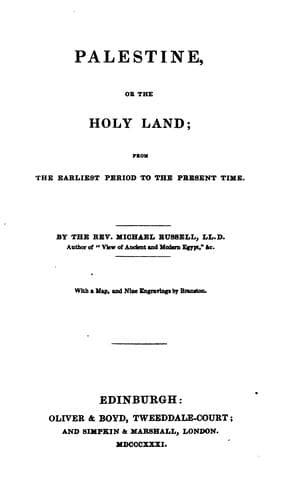
Palestine, or, the Holy Land: From the Earliest Period to the Present TimeRussell, Michael
History
Palestine, or, the Holy Land: From the Earliest Period to the Present Time
Russell, Michael
Palestine -- Description and travel; Palestine -- History
The intelligence did not fail to reach Europe that the members of the
Church in Palestine had been put to death or dispersed by the exiles of
Karism. Pope Innocent the Fourth suggested the expediency of another
Crusade, and even summoned all his faithful children to take arms. He
wrote to Henry the Third, king of England, urging him to press on his
subjects the necessity of punishing the Karismians. But the spirit of
crusading was more active in France than in any other country of the West
and it revived in all the vigour of its chivalrous piety in the reign of
Louis the Ninth. Agreeably to the superstition of the times, he had vowed,
while afflicted by a severe illness, that in case of recovery he would
travel to the Holy Land. The Cross was likewise taken by the three royal
brothers, the Counts of Artois, Poictiers, and Anjou, by the Duke of
Burgundy, the Countess of Flanders and her two sons, together with many
knights of high degree.
But it was not till 1249 that the soldiers of Louis were mustered, and his
ships prepared for sea; the former amounting to fifty thousand, while his
vessels of all descriptions exceeded eighteen hundred. They set sail for
Egypt; a storm separated the fleet; but the royal division, in which were
nearly three thousand knights and their men-at-arms, arrived in the
neighbourhood of Damietta. On the second day the king ordered the
disembarkation; he himself leaped into the water; his warriors followed
him to the shore; upon which the Saracens, panic-struck at their boldness
and determination, made but a slight show of defence, and fled into the
interior. Although Damietta was better prepared for a siege than at that
period when it defied the arms of the Crusaders during eighteen months,
yet the garrison were pleased to seek safety in the fleetness of their
horses. Louis fixed his residence in the city; a Christian government was
established; and the clergy, as they were wont on such occasions,
proceeded to purify the mosques.
Public-domain text, read in full here on John Shaqi.
Reviews
Reviews
No reviews yet
Be the first to share your thoughts on this work.
Elsewhere in the archive
Join the Discussion
Join the discussion
Sign in to leave a comment or review.
Sign InorCreate an account