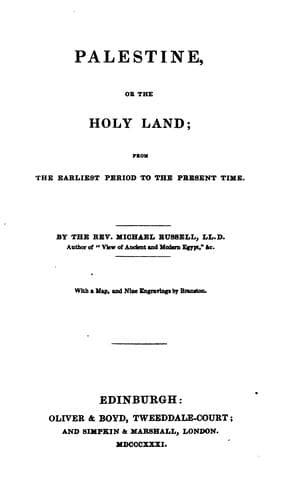
Palestine, or, the Holy Land: From the Earliest Period to the Present TimeRussell, Michael
History
Palestine, or, the Holy Land: From the Earliest Period to the Present Time
Russell, Michael
Palestine -- Description and travel; Palestine -- History
In a pastoral country, such as that beyond the river Jordan especially,
where the desert in most parts bordered upon the cultivated soil, the
limits of the several possessions could not at all times be distinctly
marked. It is well known, besides, that the native inhabitants were never
entirely expelled by the victorious Hebrews, but that they retained, in
some instances by force, and in others by treaty, a considerable portion
of land within the borders of all the tribes,--a fact which is connected
with many of the defections and troubles into which the Israelites
subsequently fell.
CHAPTER II.
_History of the Hebrew Commonwealth_.
Form of Government after the Death of Joshua; In Egypt; In the Wilderness;
Princes of Tribes and Heads of Families; Impatience to take Possession
of Promised Land; The Effects of it; Renewal of War; Extent of Holy
Land; Opinions of Fleury, Spanheim, Reland, and Lowman; Principle of
Distribution; Each Tribe confined to a separate Locality; Property
unalienable; Conditions of Tenure; Population of the Tribes; Number of
Principal Families; A General Government or National Council; The Judges;
Nature of their Authority; Not ordinary Magistrates; Different from Kings,
onsuls, and Dictators; Judicial Establishments; Judges and Officers;
Described by Josephus; Equality of Condition among the Hebrews; Their
Inclination for a Pastoral Life; Freebooters, like the Arabs; Abimelech,
Jephthah, and David; Simplicity of the Times; Boaz and Ruth; Tribe of
Levi; Object of their Separation; The learned Professions hereditary,
after the manner of the Egyptians; The Levitical Cities; Their Number
and Uses; Opinion of Michaelis; Summary View of the Times and Character
of the Hebrew Judges.
Learned men have long exercised their ingenuity with the view of
determining the precise form of the social condition which was assumed by
the Israelites when they took possession of the Promised Land. The sacred
writer contents himself with stating, that "it came to pass a long time
after the Lord had given rest unto Israel from all their enemies round
about, that Joshua waxed old and stricken in age; and he called for all
Israel, for their elders, and for their heads, and for their judges, and
for their officers." The purport of the address he delivered on this
occasion, and which is given at length in the twenty-third chapter of the
book which bears his name, was solely to remind them of their religious
obligations as the chosen people of Jehovah, and of the labors that they
had yet to undergo in subduing the remainder of Canaan. Neither in this
speech, nor in the exhortation with which he afterward at Shechem
endeavoured to animate the zeal and constancy of his followers, did he
make any allusion to the form of government that it behoved them to adopt;
declining even to direct their choice in the appointment of a chief, who
might conduct their armies in the field, and preside in the deliberations
of the national council.
Public-domain text, read in full here on John Shaqi.
Reviews
Reviews
No reviews yet
Be the first to share your thoughts on this work.
Join the Discussion
Join the discussion
Sign in to leave a comment or review.
Sign InorCreate an account