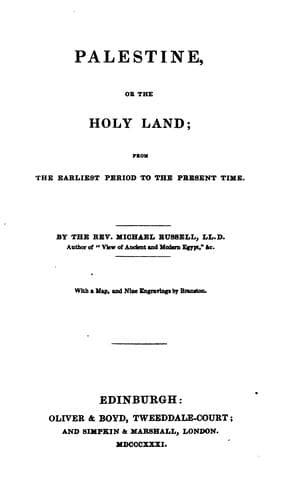
Palestine, or, the Holy Land: From the Earliest Period to the Present TimeRussell, Michael
History
Palestine, or, the Holy Land: From the Earliest Period to the Present Time
Russell, Michael
Palestine -- Description and travel; Palestine -- History
The first events which occurred after the demise of Joshua appear to
establish the fact, that to every tribe was committed the management of
its own affairs, even to the extent of being entitled to wage war and make
peace without the advice or sanction of the general senate. The only
government to which the sons of Jacob had hitherto been accustomed, was
that most ancient and universal system of rule which gives to the head of
every family the direction and control of all its members. We find traces
of this natural subordination among them, even under the pressure of
Egyptian bondage. During the negotiations which preceded their deliverance
under the ministry of Moses, the applications and messages were all
addressed to the patriarchal rulers of the people. "Go gather the elders
of Israel together," was the command of Jehovah to the son of Amram, when
the latter received authority to rescue the descendants of Isaac from the
tyranny of Pharaoh.
But during the pilgrimage in the wilderness, and more particularly when
the tribes approached the confines of the devoted nations of Canaan, the
original jurisdiction of the family chiefs was rendered subordinate to the
military power of their inspired leader, who, as the commander of the
armies of Israel, was esteemed and obeyed by his followers as the
lieutenant of the Lord of Hosts. In truth, the martial labours to which
his office called him, placed the successor of Moses at the head of his
countrymen in quality of a general, guiding them on their march or forming
their array in the field of battle, rather than as a teacher of wisdom or
the guardian of a peculiar faith and worship. Until the conquered lands
were divided among the victorious tribes, Joshua was a soldier and nothing
more; while, on the other hand, the congregation of the Hebrews, who
seconded so well his military plans, appear at that juncture on the page
of history in no other light than that of veteran troops, rendered hardy
by long service in a parching climate, and formidable by the arts of
discipline under a skilful and warlike leader.
Public-domain text, read in full here on John Shaqi.
Reviews
Reviews
No reviews yet
Be the first to share your thoughts on this work.
Join the Discussion
Join the discussion
Sign in to leave a comment or review.
Sign InorCreate an account