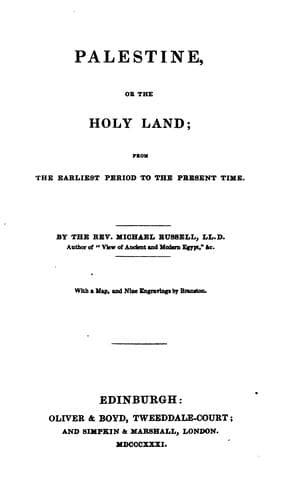
Palestine, or, the Holy Land: From the Earliest Period to the Present TimeRussell, Michael
History
Palestine, or, the Holy Land: From the Earliest Period to the Present Time
Russell, Michael
Palestine -- Description and travel; Palestine -- History
During the siege of Acre, the several detachments of the French army
stationed in Galilee were attacked by a powerful Mussulman force, which
had assembled in the adjoining mountains. Junot, who was induced to risk
an engagement near Nazareth, would have been cut in pieces by the Mamlouk
cavalry, had not Bonaparte hastened to his assistance We have already
alluded to the masterly conduct of Kleber, who, at the head of a few
hundred men, kept the field a whole day against an overwhelming mass of
horsemen that attacked his party near Mount Tabor. On this occasion, too,
the speedy aid of Napoleon secured a victory, and scattered the enemy's
troops over the face of the desert. But he found, upon his return to the
trenches, that the same men whose columns dissipated like smoke before his
battalions on the plain were extremely formidable behind an armed wall,
and that all the skill of his engineers and the bravery of his veterans
were of no avail when opposed by the savage courage of Turks directed by
European officers and supported by English seamen.
The sufferings which the French endured in their retreat across the desert
were very great, and afforded constant exercise for the self-possession
and equanimity of their leader. "A fearful journey," says one of their
number, "was yet before us. Some of the wounded were carried in litters,
and the rest on camels and mules. A devouring thirst, the total want of
water, an excessive heat, a fatiguing march among scorching sand-hills,
demoralized the men; a most cruel selfishness, the most unfeeling
indifference, took place of every generous or humane sentiment. I have
seen thrown from the litters officers with amputated limbs, whose
conveyance had been ordered, and who had themselves given money as a
recompense for the fatigue. I have beheld abandoned among the wheatfields
soldiers who had lost their legs or arms, wounded men, and patients
supposed to be affected with the plague. Our march was lighted up by
torches kindled for the purpose of setting on fire towns, hamlets, and the
rich crops with which the earth was covered. The whole country was in
flames. It seemed as if we found a solace in this extent of mischief for
our own reverses and sufferings. We were surrounded only by the dying, by
plunderers, by incendiaries. Wretched beings at the point of death, thrown
by the wayside, continued to call with feeble voice, 'I have not the
plague, I am but wounded;' and, to convince those that passed, they might
be seen tearing open their real wounds, or inflicting new ones. Nobody
believed them. It was the interest of all not to believe. Comrades would
say, 'He is done for now; his march is over;' then pass on, look to
themselves, and feel satisfied. The sun, in all his splendour under that
beautiful sky, was obscured by the smoke of continual conflagration. We
had the sea on our right; on our left and behind us lay the desert which
we had made; before were the sufferings and privations that awaited
us."[183]
Public-domain text, read in full here on John Shaqi.
Reviews
Reviews
No reviews yet
Be the first to share your thoughts on this work.
Elsewhere in the archive
Join the Discussion
Join the discussion
Sign in to leave a comment or review.
Sign InorCreate an account