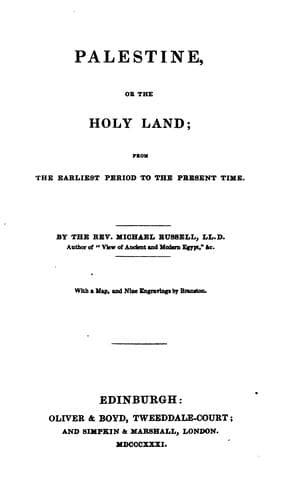
Palestine, or, the Holy Land: From the Earliest Period to the Present TimeRussell, Michael
History
Palestine, or, the Holy Land: From the Earliest Period to the Present Time
Russell, Michael
Palestine -- Description and travel; Palestine -- History
During the period to which this part of our narrative refers, the supreme
power among the Hebrews was occasionally exercised by judges,--an order of
magistrates to which nothing similar is to be found in any other country.
The Carthaginians, indeed, had a description of rulers, whose names, being
derived from the same oriental term, appear to establish some resemblance
in their office to that of the successors of Joshua. But it will be found
upon a comparison of their authority, both in its origin and the purposes
to which it was meant to be subservient, that the Hebrew judges and the
suffites of Carthage had very little in common. Nor do we find any closer
analogy in the duties of a Grecian archon or of a Roman consul. These were
ordinary magistrates, and periodically elected; whereas the judge was
never invested with power except when the exigencies of public affairs
required the aid of extraordinary talents or the weight of a supernatural
appointment. On this account the Hebrew commander has been likened to the
Roman dictator, who, when the commonwealth was in danger, was intrusted
with an authority almost unlimited; and with a jurisdiction which extended
to the lives and fortunes of nearly all his countrymen. But in one
important particular this similarity fails. The dictator laid down his
office as soon as the crisis which called for its exercise had passed
away; and in no circumstances was he entitled to retain such unwonted
supremacy beyond a limited time. The judge, on the other hand, remained
invested with his high authority during the full period of his life, and
is therefore usually described by the sacred historian as presiding to the
end of his days over the tribes of Israel, amid the peace and security
which his military skill, aided by the blessing of Heaven, had restored to
their land.[21]
The Hebrew judges, says Dupin, were not ordinary magistrates, but men
raised up by God, on whom the Israelites bestowed the chief government,
either because they had delivered them from the oppressions under which
they groaned, or because of their prudence and equity. They ruled
according to the law of Jehovah, commanded their armies, made treaties
with the neighbouring princes, declared war and peace, and administered
justice. They were different from kings,--
1. In that they were not established either by election or succession,
but elevated to power in an extraordinary manner.
2. In that they refused to take upon them the title and quality of king.
3. In that they levied no taxes upon the people for the maintenance of
government.
4. In their manner of living, which was very far from the pomp and
ostentation of the regal state.
5. In that they could make no new laws, but governed according to the
statutes contained in the Books of Moses.
6. In that the obedience paid to them by the people was voluntary and
unforced, being at most no more than consuls and magistrates of free
cities.[22]
Public-domain text, read in full here on John Shaqi.
Reviews
Reviews
No reviews yet
Be the first to share your thoughts on this work.
Join the Discussion
Join the discussion
Sign in to leave a comment or review.
Sign InorCreate an account