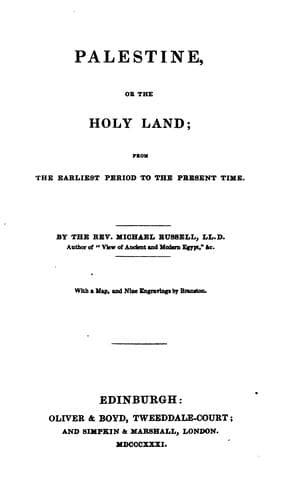
Palestine, or, the Holy Land: From the Earliest Period to the Present Time — John Shaqi
Palestine, or, the Holy Land: From the Earliest Period to the Present TimeRussell, Michael
History
Palestine, or, the Holy Land: From the Earliest Period to the Present Time
Russell, Michael
Palestine -- Description and travel; Palestine -- History
It has been justly remarked, at the same time, that however extensive the
power might be which was committed to the supreme court of the nation, and
how much soever the authority of a military judge among the Israelites
resembled that of a Roman dictator, the privilege of making laws was at no
period intrusted to any order of the Jewish state. As long as the Hebrews
were governed by a theocracy, this essential prerogative was retained by
the Divine Head of the nation. "Now therefore hearken, O Israel, unto the
statutes, and unto the judgments, which I teach you, for to do them, that
ye may live, and go in and possess the land which the Lord God of your
fathers giveth you. Ye shall not add unto the word which I command you,
neither shall ye diminish aught from it, that ye may keep the commandments
of the Lord your God which I command you."[20]
It is the opinion of learned men, that the Council of Seventy, established
by Moses in the Wilderness, was only a temporary appointment, and did not
continue after the Hebrews were settled in the Land of Canaan. The only
national assembly of which we can discover any trace subsequently to that
event, is the occasional meeting of the Princes of Tribes and Chiefs of
Families to transact business of great public importance. Thus, in the
case of the war against Benjamin, of which we have a full account in the
book of Judges, we are informed that the heads "of all the tribes, even of
all the tribes of Israel, presented themselves in the assembly of the
people of God." On that memorable occasion, the interests and character of
the whole Hebrew commonwealth were at stake; for which reason the natural
leaders of the tribes gathered themselves together at the head of their
kinsmen and followers,--even four hundred thousand men that drew the
sword,--in order to consult with one another, and to adopt such measures
as might be deemed most suitable for punishing the atrocities which had
been committed at Gibeah.
Public-domain text, read in full here on John Shaqi.
Reviews
Reviews
No reviews yet
Be the first to share your thoughts on this work.
Join the Discussion
Join the discussion
Sign in to leave a comment or review.
Sign InorCreate an account