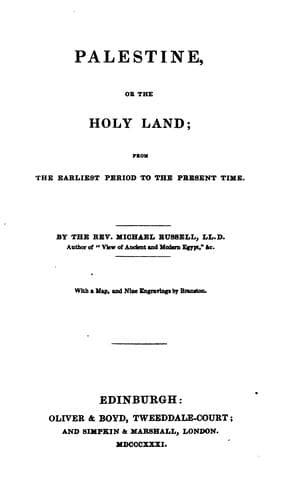
Palestine, or, the Holy Land: From the Earliest Period to the Present TimeRussell, Michael
History
Palestine, or, the Holy Land: From the Earliest Period to the Present Time
Russell, Michael
Palestine -- Description and travel; Palestine -- History
Nor did David himself think it unsuitable to his high prospects to have
recourse for a time to a predatory life. When compelled to flee from the
presence of Saul, he took refuge in the cave of Adullam; "and every one
that was in distress, and every one that was in debt, and every one that
was discontented gathered themselves unto him, and he became a captain
over them." It has been suggested, indeed, that the son of the
Bethlehemite employed his arms against such persons only as were enemies
to the Hebrews. But there is no good ground for this distinction. His
conduct to Nabal, whose possessions were in Carmel, proves, that when his
camp was destitute of provisions he deemed it no violation of honour to
force a supply for the wants of his men, even from the stores of a
friendly house. We may judge, moreover, of the character of his followers,
as well from the remonstrance that was made by the parsimonious rustic to
whom he sent them, as from the effect which a refusal produced upon their
ardent tempers. "Who is David? and who is the son of Jesse? There be many
servants now-a-days that break away every man from his master. Shall I
then take my bread, and my water, and my flesh that I have killed for my
shearers, and give it unto men whom I know not whence they be?--So David's
young men turned their way, and went again, and told him all those
sayings. And David said unto his men, Gird ye on every man his sword. And
they girded on every man his sword, and David also girded on his sword:
and there went after David about four hundred men, and two hundred abode
by the stuff."[28]
It is manifest, that in the simple condition of society to which our
attention is now directed, the profession of a freebooter was not in any
sense accounted dishonourable. The courage and dexterity which such a life
requires stand high in the estimation of tribes who are almost constantly
in a state of war; and hence, in reading the history of the ancient
Israelites, we must form an opinion of their manners and principles, not
according to the maxims of an enlightened age, but agreeably to the
habits, pursuits, and mental cultivation which belonged to their own
times.
Public-domain text, read in full here on John Shaqi.
Reviews
Reviews
No reviews yet
Be the first to share your thoughts on this work.
Join the Discussion
Join the discussion
Sign in to leave a comment or review.
Sign InorCreate an account