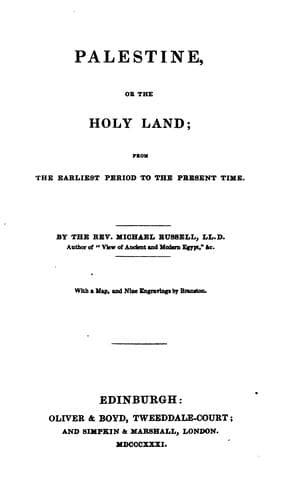
Palestine, or, the Holy Land: From the Earliest Period to the Present TimeRussell, Michael
History
Palestine, or, the Holy Land: From the Earliest Period to the Present Time
Russell, Michael
Palestine -- Description and travel; Palestine -- History
Among the Arabs, even at the present day, the pastoral life is accounted
more noble than that which leads to a residence in towns, or even in
villages. They think it, as Arvieux remarks, more congenial to liberty;
because the man who with his herds ranges the desert at large will be far
less likely to submit to oppression than people with houses and lands.
This mode of thinking is of great antiquity in the eastern parts of the
world. Diodorus Siculus, when speaking of the Nabathaeans, relates, that
they were by their laws prohibited from sowing, planting, drinking wine,
and building houses; every violation of the precept being punishable with
death. The reason assigned for this very singular rule is, their belief
that those who possess such things will be easily brought into subjection
by a tyrant; on which account they continue, says the historian, to
traverse the desert, feeding their flocks, which consist partly of camels
and partly of sheep.
The fact now stated receives a remarkable confirmation from the notice
contained in the book of Jeremiah respecting the Rechabites, who, though
they had for several ages been removed from Arabia into Palestine,
persevered in a sacred obedience to the command of their ancestor,
refusing to build houses, sow land, plant vineyards, or drink wine, but
resolving to dwell in tents throughout all their generations.
In regard to these points, the Hebrews, in the early age at which we are
now considering them, appear to have entertained sentiments not very
different from those of the Arabs, from whose sandy plains they had just
emerged. The life of a migratory shepherd, too, has a very close alliance
with the habits of a freebooter; and the attentive reader of the ancient
history of the Israelites will recollect many instances wherein the
descendants of Isaac gave ample proof of their relationship to the
posterity of Ishmael. The character of Abimelech, the son of Gideon, for
example, cannot be viewed in any other light than that of a captain of
marauders. The men of Shechem, whom he had hired to follow him, refused
not to obey his commands, even when he added murder to robbery. Jephthah,
in like manner, when he was thrust out by his brethren, became the chief
of a band of freebooters in the land of Tob. "And there were gathered vain
men to Jephthah, and went out with him." But the elders of Gilead did not
on that account regard their brave countryman as less worthy to assume the
direction of their affairs, and to be head over all the inhabitants of
their land,--an honour which he even hesitated to accept when compared
with the rank and emolument of the less orderly situation which they
requested him to relinquish.
Public-domain text, read in full here on John Shaqi.
Reviews
Reviews
No reviews yet
Be the first to share your thoughts on this work.
Join the Discussion
Join the discussion
Sign in to leave a comment or review.
Sign InorCreate an account