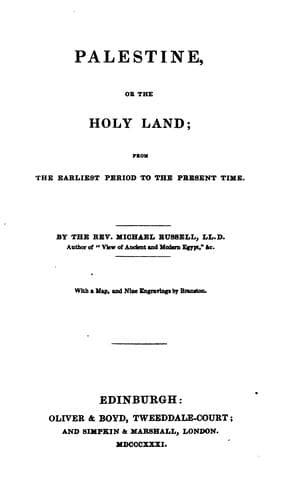
Palestine, or, the Holy Land: From the Earliest Period to the Present TimeRussell, Michael
History
Palestine, or, the Holy Land: From the Earliest Period to the Present Time
Russell, Michael
Palestine -- Description and travel; Palestine -- History
In truth, it should seem that even before the days of Samuel the opinions,
or rather perhaps the popular notions connected with the name and offices
of a prophet, had undergone some change, and began to point to higher
objects. Saul, when employed in seeking his father's asses, had journeyed
so far from home that he despaired of finding his way thither; and when he
was come to the land of Zuph he said to his servant, "Come, and let us
return; lest my father leave caring for the asses, and take thought for
us. And he said unto him, Behold now, there is in this city a man of God,
and he is an honourable man; all that he saith cometh surely to pass: now
let us go thither; peradventure he can show us our way that we should go.
Then said Saul to his servant, But, behold; if we go, what shall we bring
the man; for the bread is spent in our vessels, and there is not a present
to bring to the man of God; what have we? And the servant answered Saul
again, and said, Behold, I have here at hand the fourth part of a shekel
of silver; that will I give to the man of God to tell us our way.
(Beforetime in Israel, when a man went to inquire of God, thus he spake,
Come, and let us go to the seer: for he that is now called a prophet was
beforetime called a seer.) Then said Saul to his servant, Well said; come,
let us go. So they went unto the city where the man of God was."[51]
The description of soothsayer whom Saul and his servant had resolved to
consult is very common in all lands at a certain stage of knowledge and
civilization,--a personage who, without much reliance on Divine aid, could
amuse the curiosity of a rustic and perplex his ignorance with an
ambiguous answer. But the age of Samuel required more solid qualifications
in the prophets, and hence the term seer had already given way to that of
expounder or master of eloquence and wisdom. The expedient suggested by
the attendant of the son of Kish was very natural, and quite consistent
with his rank and habits; while the easy acquiescence which he obtained
from his master denotes the simplicity of ancient times, not less than the
untutored state of mind in which the future King of Israel had left his
parent's dwelling. Before he mounted the throne, however, he was sent to
acquire the elements of learning among the sons of the prophets; whom, in
a short time, he accompanied in their pious exercises in a manner so
elevated as to astonish every one who had formerly known the young
Benjamite; till then remarkable only for a mild disposition and great
bodily strength.
Public-domain text, read in full here on John Shaqi.
Reviews
Reviews
No reviews yet
Be the first to share your thoughts on this work.
Elsewhere in the archive
Join the Discussion
Join the discussion
Sign in to leave a comment or review.
Sign InorCreate an account