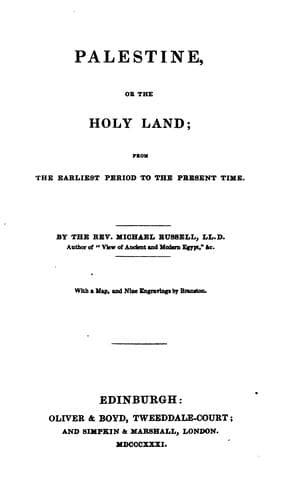
Palestine, or, the Holy Land: From the Earliest Period to the Present TimeRussell, Michael
History
Palestine, or, the Holy Land: From the Earliest Period to the Present Time
Russell, Michael
Palestine -- Description and travel; Palestine -- History
The mental bias towards prediction, which is almost unavoidably acquired
by the practice of elucidation and commentary on a dark text, soon showed
itself in the schools of the prophets. Many of them, trusting to their own
ingenuity rather than to the suggestion of the Spirit of Truth, ventured
to foretel the issue of events, and to delineate the future fortunes of
nations, as well as of individuals. Hence the race of false prophets, who
brought so much obloquy upon the whole order, and not unfrequently barred
against the approach of godly admonition the ears of those who were
actually addressed by an inspired messenger. Nay, it appears that some of
them arrogated the power of realizing the good or the evil which they were
pleased to foretel; allowing the people to believe that they were
possessed with demons, who enabled them, not only to foresee, but to
influence in no small measure the course of Providence. The impression on
the mind of Ahab in regard to Micaiah leaves no room for doubt that the
king imagined the prophet to be actuated by a malignant feeling towards
him. "I hate him," he exclaimed, "for he doth not prophesy good concerning
me, but evil." Nor was the conviction that this ungracious soothsayer
spoke from his own wishes rather than from a divine impulse confined to
the Israelitish monarch. The messenger who was sent to call Micaiah spake
unto him, saying, "Behold now, the words of the prophets declare good unto
the king with one mouth: let thy word, I pray thee, be like the word of
one of them, and speak that which is good."[52]
When we consider the uncertainty which must have attended all predictions,
where the wishes or feelings of the prophet could give a different
expression to the purposes of God, we cannot any longer be surprised at
the neglect with which such announcements were frequently treated by those
to whom they were addressed. It is remarkable, too, that one prophet did
not possess the gift of ascertaining the truth or sincerity of another who
might declare that he spoke in the name of God; and hence there were no
means of determining the good faith of this order of men, except the
general evidence of a pious character, or the test of a successful
experience. For example, when Jeremish proclaimed the approaching fall of
Jerusalem, the other prophets were among the first to oppose him, saying,
"Thou shalt surely die: why hast thou prophesied in the name of the Lord
that this house shall be like Shiloh, and this city shall be desolate
without an inhabitant?" The princes of Judah assembled in the Temple to
hear the charge repeated against this fearless minister; when again,
"spake the priests and the prophets unto the princes, and to all the
people, saying, This man is worthy to die; for he hath prophesied against
this city, as ye have heard with your ears."
Public-domain text, read in full here on John Shaqi.
Reviews
Reviews
No reviews yet
Be the first to share your thoughts on this work.
Elsewhere in the archive
Join the Discussion
Join the discussion
Sign in to leave a comment or review.
Sign InorCreate an account