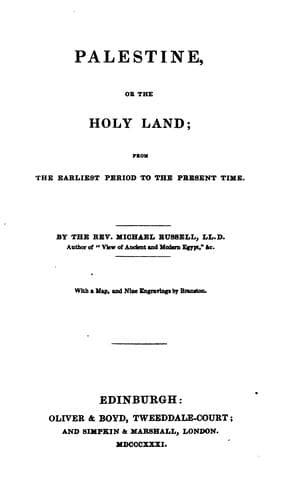
Palestine, or, the Holy Land: From the Earliest Period to the Present TimeRussell, Michael
History
Palestine, or, the Holy Land: From the Earliest Period to the Present Time
Russell, Michael
Palestine -- Description and travel; Palestine -- History
One-half of these months consisted of thirty days, the other of
twenty-nine, alternately making in all three hundred and fifty-four. To
supply the eleven days and six hours which were deficient, they introduced
every second year an additional month of twenty-two days, and every fourth
year one of twenty-three days; by which means they approached as nearly to
the true measure as any other nation had attained till the establishment
of the Gregorian calendar.
The Hebrews divided the space from sunrise to sunset into twelve equal
parts, and hence the hours of their day varied in length according to the
season of the year. For example, when the sun rose at five and set at
seven, an hour contained seventy minutes; but when it rose at seven and
set at five, the hour was reduced to fifty minutes, and so on in
proportion to the duration of the time that the sun was above the horizon.
A similar rule applied to the night, which was likewise divided into
twelve equal portions.
It must be acknowledged, however, that the observations now made apply
rather to the acquirements of the Jews after their return from the East,
than to the more simple condition in which they appear under their judges
and prophets.
Next to the learning of this early period, the reader of the sacred
history will have his curiosity excited in regard to the time, the place,
and the manner of religious worship. When the Israelites had obtained
possession of the Holy Land, and distributed the territory among their
tribes, the tabernacle, or ambulatory temple, was placed at Shiloh, a town
in the possession of Ephraim. To that sacred retreat the Hebrews were wont
to travel at the three great festivals, to accomplish the service enjoined
by their law.
But it appears that a more ordinary kind of religious duty was performed
at certain stations within the several tribes, in the intervals between
the stated feasts appointed fur the whole nation; having some reference,
it is probable, to the periodical return of the Sabbath and new moons. For
this purpose the people seem to have repaired to high places, where they
might more readily perceive the lunar crescent, and give utterance to
their customary expression of gratitude and joy. This species of adoration
was connived at rather than authorized by the priests and Levites, who
found it impossible to check altogether the propensity of the multitude to
perform their worship on the high hill and under the green tree. Samuel,
the prophet and judge, saw the expediency on one occasion of building an
altar unto the Lord on Ramah, which is called the High Place; and in the
reign of Solomon the same practice was confirmed, "because there was no
house built unto the name of the Lord until those days."[60]
Public-domain text, read in full here on John Shaqi.
Reviews
Reviews
No reviews yet
Be the first to share your thoughts on this work.
Elsewhere in the archive
Join the Discussion
Join the discussion
Sign in to leave a comment or review.
Sign InorCreate an account