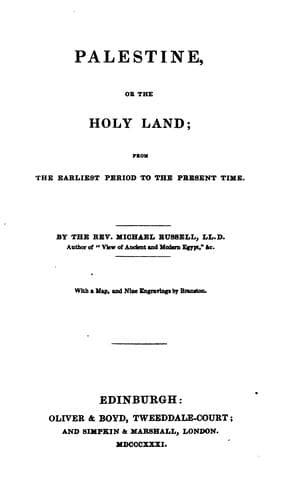
Palestine, or, the Holy Land: From the Earliest Period to the Present TimeRussell, Michael
History
Palestine, or, the Holy Land: From the Earliest Period to the Present Time
Russell, Michael
Palestine -- Description and travel; Palestine -- History
It is difficult to determine with precision at what epoch the Hebrews
first formed those meetings or congregations which are called
synagogues,--a name afterward more frequently applied to the buildings in
which they convened. The earliest allusion to them is found in the
seventy-fourth Psalm, where the writer, describing the havoc committed by
the Assyrians, remarks, "they have burnt up all the synagogues of God in
the land." We might infer, from this statement alone, that such edifices
were common before the Babylonian captivity; but we are supplied with a
more direct proof in the words of St. James, who informs us that "Moses of
old time hath in every city them that preach him, being read in the
synagogues every Sabbath-day."[61]
The duty in these places, which was confined to prayer and exposition, was
performed by that section of the Levites who are usually denominated
scribes; the higher office of sacrifice, the scene of which was first the
tabernacle and afterward the temple, being confined to the priests, the
sons of Aaron. Perhaps in remote places, where the population was small,
the inhabitants met in the house of the Levite, a conjecture which derives
some plausibility from an affecting incident mentioned in the second book
of the Kings. When the son of the woman of Shunem died, "she called unto
her husband and said, send me, I pray thee, one of the young men, and one
of the asses, that I may run to the man of God. And he said, wherefore
wilt thou go? it is neither new moon nor Sabbath." It is reasonable to
conclude, that on these days it was customary to repair to the dwelling of
the holy man for religious purposes.
We have already alluded to the fact, that at the first settlement of the
Promised Land the tabernacle was established in Shiloh, a village in
Ephraim, at that time the most numerous and powerful of all the tribes.
The profanity or, disobedience of the people in this district led to the
removal of the Divine presence, the symbols of which were commanded to be
deposited in Jerusalem. "Go ye," says the prophet Jeremiah, "unto my place
which was in Shiloh, where I set my name at the first; and see what I did
to it for the wickedness of my people Israel." Hence the origin of the
feud which subsisted so long between Ephraim and Judah, and afterward
between the Jews and Samaritans, in regard to the spot where Jehovah ought
to be worshipped. Each laid claim to a Divine appointment; neither would
yield to the other or hold the slightest intercourse in their adoration of
the same great Being; and the question remained as far as ever from being
determined when the Romans finally cut down all distinctions by their
victorious arms.
Public-domain text, read in full here on John Shaqi.
Reviews
Reviews
No reviews yet
Be the first to share your thoughts on this work.
Elsewhere in the archive
Join the Discussion
Join the discussion
Sign in to leave a comment or review.
Sign InorCreate an account