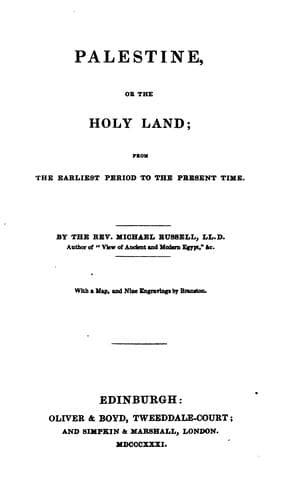
Palestine, or, the Holy Land: From the Earliest Period to the Present TimeRussell, Michael
History
Palestine, or, the Holy Land: From the Earliest Period to the Present Time
Russell, Michael
Palestine -- Description and travel; Palestine -- History
Our limits will not permit us to indulge in a minute account of the Jewish
festivals. Still the three great institutions at which all the males of
the Hebrew nation were commanded to appear before Jehovah are so
frequently mentioned in the history of the Holy Land, that we must take
leave to specify their general objects. The feast of the Passover,
comprehending that of unleavened bread, commemorated the signal
deliverance of this wonderful people from the tyranny of Pharaoh. It was
to be kept upon the fifteenth day of the first month, to last seven days,
and to begin, as all their festivals began, the evening before at the
going down of the sun.
The reader will attend to the distinction just stated--the beginning and
end of their sacred days. The celebration of the ordinary Sabbath, indeed,
commenced on the evening of Friday, and terminated at the going down of
the sun on Saturday. "From even unto even shall ye celebrate your
Sabbaths." But the Jews, in the concluding period of their government, had
innovated so far on the Mosaical institution as to prohibit the passover
from being observed on Monday, Wednesday, or Friday, and to appoint the
celebration of it on the following day. The year in which our Lord
suffered death this great annual feast fell on a Friday--beginning, as
already stated, at sunset on Thursday evening--and the Redeemer
accordingly, who came to fulfil all righteousness, ate the paschal supper
with his disciples on the evening of Thursday. Yet the Jews, we find from
the evangelical narrative, were not to observe that rite till the
following evening; and hence, the early part of Friday being the
preparation, they would not go into the judgment hall "lest they should be
defiled, but that they might eat the passover" after the going down of the
sun. For the same reason they besought Pilate that the bodies might be
removed; intimating that the day which was to begin at sunset was to them
a high day, being in fact not only the Sabbath, but also the paschal
feast, both extremely solemn in the estimation of every true Israelite.
On the ground now stated is easily explained the apparent discrepancy
between the account given by St. John and that of the other Evangelists.
They tell us that our Lord celebrated the passover on Thursday evening the
first day of the yearly festival; whereas the beloved disciple relates,
that the neat morning was still the preparation of that ordinance which
was to be observed by the whole nation the ensuing night. Both statements
are perfectly correct; only our Saviour adhered to the day fixed by the
original institution, while the priests and lawyers followed the rule
established by the Sanhedrim, which threw the festival a day after its
proper time.
Public-domain text, read in full here on John Shaqi.
Reviews
Reviews
No reviews yet
Be the first to share your thoughts on this work.
Elsewhere in the archive
Join the Discussion
Join the discussion
Sign in to leave a comment or review.
Sign InorCreate an account