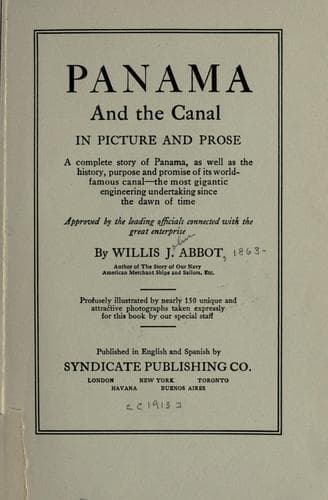
Panama and the Canal in Picture and ProseAbbot, Willis J. (Willis John)
History
Panama and the Canal in Picture and Prose
Abbot, Willis J. (Willis John)
Panama Canal (Panama) -- History
Four classes of citizens, European Spaniards, their sons, born on the
Isthmus, and called creoles, the Indians and the negroes, made up the
population and were too diverse by birth and nature to unite for any
patriotic purpose. Accordingly through the period of breaking shackles,
which made Bolivar famous the world over and created the great group of
republics in South America, the state of which the Isthmus was a part
remained quiescent. In 1814 revolutionists vainly tried to take Porto
Bello, but that famous fortress which never resisted a foreign foe
successfully, beat off the patriots. Panama was at this time in high
favor at Madrid because of its loyalty and the Cortes passed resolutions
for the building of a canal, but went no further. But all the time the
revolutionary leaven was working beneath the surface. In 1821 a field
marshal from Spain, charged with the task of crushing out the revolution
in Colombia and Ecuador, stripped Porto Bello, San Lorenzo and Panama of
the greater part of their garrisons and took them to Guayaquil. By
bribes and promises the local patriots persuaded the few soldiers
remaining to desert and, with no possibility of resistance, the
independence of Panama from Spain was declared. Early in 1822 Panama
became the Department of the Isthmus in the Republic of Colombia.
It would be idle to describe, even to enumerate, all the revolutions
which have disquieted the Isthmus since it first joined Colombia in
repudiating the Spanish rule. They have been as thick as insects in the
jungle. No physical, social or commercial ties bound Panama to Colombia
at any time during their long association. A mountain range divided the
two countries and between the cities of Panama and Bogotá there was no
communication by land. In foreign commerce the province of Panama
exceeded the parent state, while the possession of the shortest route
across the Isthmus was an asset of which both Bogotáns and Panamanians
keenly realized the value.
[Illustration: _Photo by Underwood & Underwood_
ENTRANCE TO MT. HOPE CEMETERY]
Public-domain text, read in full here on John Shaqi.
Reviews
Reviews
No reviews yet
Be the first to share your thoughts on this work.
Elsewhere in the archive
Join the Discussion
Join the discussion
Sign in to leave a comment or review.
Sign InorCreate an account