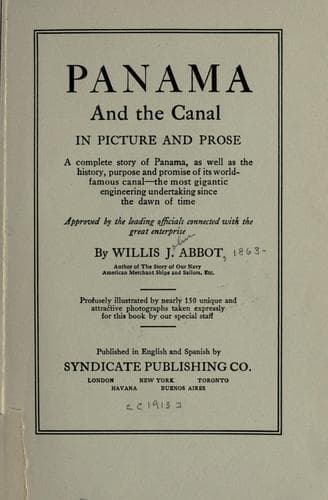
Panama and the Canal in Picture and ProseAbbot, Willis J. (Willis John)
History
Panama and the Canal in Picture and Prose
Abbot, Willis J. (Willis John)
Panama Canal (Panama) -- History
In 1898 the race of the battleship “Oregon” around Cape Horn to join the
United States fleet off Cuba in the Spanish-American war offered just
the graphic and specific argument necessary to fix the determination of
the American people to dig that canal and to own it. That voyage of
10,000 miles which might have been avoided by a ditch fifty miles long
revolted the common sense of the nation, and the demand for instant
action on the canal question was universal. Accordingly in 1899
President McKinley appointed what was known as the Walker Commission,
because headed by Admiral John G. Walker, to investigate all Central
American routes. They had the data collected during almost a century at
their disposal and very speedily settled down to the alternative between
the Panama and the Nicaragua routes. Over this choice controversy raged
long and noisily. While it was in progress the bullet of an assassin
ended the life of President McKinley and Theodore Roosevelt succeeded
him.
The Isthmian Canal was precisely the great, epoch-marking spectacular
enterprise to enlist the utmost enthusiasm and energy of this peculiarly
dynamic President. A man of strong convictions he favored the Panama
route--and got it. He believed in a lock canal--and enforced his beliefs
over the report of the engineers whose expert professional opinions he
invited. Of a militant temperament he thought the canal should be dug by
the army--and that is the way it was built. Not over tolerant of other
people’s rights he thought the United States should have a free hand
over the canal and adjacent territory--and when Colombia, which happened
to own that territory, was slow in accepting this view he set up out of
nothing over night the new Republic of Panama, recognized it as a
sovereign state two days afterwards, concluded a treaty with it, giving
the United States all he thought it should have, and years later, in a
moment of frankness declared “I took Panama, and left Congress to debate
it later.”
[Illustration: THE OFFICIAL UMPIRE, COCLE]
About the political morality and the personal ethics of the Roosevelt
solution of the diplomatic problem there will ever be varying opinions.
Colombia is still mourning for her ravished province of Panama and
refuses to be comforted even at a price of $10,000,000 which has been
tentatively offered as salve for the wound. But that the canal in 1913
is just about ten years nearer completion than it would be had not
Roosevelt been President in 1903 is a proposition generally accepted.
History--which is not always moral--is apt to applaud results regardless
of methods, and the Republic and Canal of Panama are likely to be
Roosevelt’s most enduring monuments--though the canal may outlast the
Republic.
[Illustration: _Photo by Underwood & Underwood_
THE MAN AND THE MACHINE
President Roosevelt and the monster steam shovel figure largely in the
story of Panama]
Public-domain text, read in full here on John Shaqi.
Reviews
Reviews
No reviews yet
Be the first to share your thoughts on this work.
Elsewhere in the archive
Join the Discussion
Join the discussion
Sign in to leave a comment or review.
Sign InorCreate an account