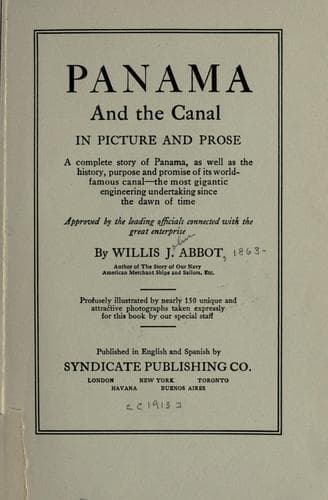
Panama and the Canal in Picture and ProseAbbot, Willis J. (Willis John)
History
Panama and the Canal in Picture and Prose
Abbot, Willis J. (Willis John)
Panama Canal (Panama) -- History
Prior to this time there had been several sporadic negotiations opened
with different nations of Central America for canal rights. The most
important one was a treaty signed at Bogotá in 1870 by an envoy
especially authorized by President Grant. But this treaty was never
ratified by our Senate, and was amended out of acceptable form by the
Colombian Senate. For the purposes of this narrative we may well
consider the diplomatic history of the canal to begin with the passage
of the Spooner act in 1902. This act, written by Senator John C. Spooner
of Wisconsin, authorized the Panama route if the French property could
be bought for $40,000,000 and the necessary right of way secured from
Colombia. Failing this the Commission of seven members created by the
act was authorized to open negotiations with Nicaragua. Events made it
quite apparent that the Nicaragua clause was inserted merely as a club
to be used in the negotiations with Colombia and the French company.
With the latter it proved highly effective, for although the American
attorney for the company, Mr. William Nelson Cromwell, fixed a price at
first upon the property of $101,141,500 an apparently active opening of
negotiations with Nicaragua caused an immediate drop to the prescribed
$40,000,000. With that offer in hand the Commission unanimously reported
to the President in favor of the Panama route.
[Illustration: _Photo by Underwood & Underwood_
LANDING PIGS FOR MARKET]
The Republic of Colombia was less tractable, and naturally so as it held
a stronger hand. When negotiations began the French concession had but
seven years more of life. If their progress could be prolonged for that
period practically all that the United States would have paid the French
would be paid to Colombia. Meanwhile the French property was wholly
unsalable without a Colombian franchise. The one weak point in the
Colombian armor was the possibility that the United States might finally
turn to Nicaragua, but this contingency was made unlikely by the report
of the Commission, and by the general desire of the American people
which was undoubtedly for the Panama route.
[Illustration: THE TRAIL NEAR CULEBRA]
Public-domain text, read in full here on John Shaqi.
Reviews
Reviews
No reviews yet
Be the first to share your thoughts on this work.
Elsewhere in the archive
Join the Discussion
Join the discussion
Sign in to leave a comment or review.
Sign InorCreate an account