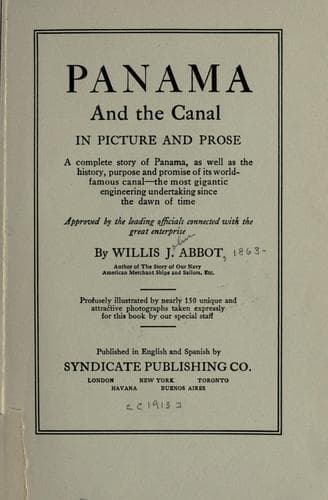
Panama and the Canal in Picture and ProseAbbot, Willis J. (Willis John)
History
Panama and the Canal in Picture and Prose
Abbot, Willis J. (Willis John)
Panama Canal (Panama) -- History
In 1903 the Colombian Minister at Washington negotiated with Senator Hay
a treaty which by a lucky chance failed of ratification in the Panama
Senate. It never reached our Senate, but it is quite incredible that it
could have succeeded there, for it had several features that would have
led to endless disagreement between the two countries--might indeed have
resulted in the United States annexing Colombia altogether. For example
the Canal Zone was to be governed by a joint commission of the two
countries--Colombia remaining sovereign over the territory. The United
States was to explicitly guarantee the sovereignty of Colombia against
all the world. Colombia was to police the Zone. Each of these sections
was big with possibilities of trouble. That Colombia did not speedily
ratify this treaty would be inexplicable, for it was all to the
Colombian good, except for the fact that by delaying any action for
seven years the French property along the line of the canal, valued at
$40,000,000, would drop into the Colombian treasury.
[Illustration: IN THE BANANA COUNTRY, ON THE COAST NEAR BOCAS DEL TORO]
Delay, however, while good enough for the Colombians, did not suit the
Panamanians, nor did it please Theodore Roosevelt, whom Providence,
while richly endowing him otherwise, had not invested with patience in
the face of opposition. The Panamanians, by whom for the purposes of
this narrative I mean chiefly the residents of Colon and the city of
Panama, wanted to see some American money spent in their various marts
of trade. The French were rapidly disappearing. The business of all
their commercial institutions from dry goods stores down to saloons was
falling off. Even the lottery did not thrive as of yore and the
proprietors of the lesser games of chance, that in those days were run
quite openly, were reduced to the precarious business of robbing each
other. All these and other vested interests called for immediate
negotiation of any sort of a treaty which would open the spigots of
Uncle Sam’s kegs of cash over the two thirsty Isthmian towns. It was
irksome too to think that the parent state of Colombia would make the
treaty and handle the cash accruing under it. The Yankees were ready to
pay $10,000,000 down, and it was believed a further rental of $250,000
for the right to build a canal every foot of which would be on the
territory of the Province of Panama. If Panama was a sovereign state
instead of merely a province, all this money would be used for the
benefit of but 400,000 people, including Indians and negroes, who of
course could not be expected to have much to say about its use. If
employed in public works, it would only have to spread over about 32,000
square miles, or a territory a little smaller than Indiana. But of
course it would chiefly go to the two cities. On the other hand if
Colombia made this treaty the capital city Bogotá would get the lion’s
share of the spoil, and for that matter all the provinces would share in
Public-domain text, read in full here on John Shaqi.
Reviews
Reviews
No reviews yet
Be the first to share your thoughts on this work.
Elsewhere in the archive
Join the Discussion
Join the discussion
Sign in to leave a comment or review.
Sign InorCreate an account