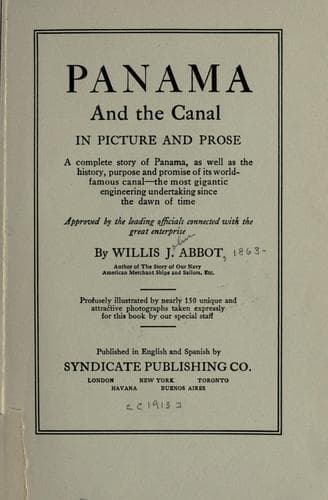
Panama and the Canal in Picture and ProseAbbot, Willis J. (Willis John)
History
Panama and the Canal in Picture and Prose
Abbot, Willis J. (Willis John)
Panama Canal (Panama) -- History
the division with Panama, which had the goods for sale.
[Illustration: _Photo by Underwood & Underwood_
THE BEST RESIDENCE SECTION, COLON]
What more natural than that the Panamanians should turn their thoughts
toward secession from Colombia? It was no novel channel for their
meditations, for, as has been pointed out already, there had been 53
revolutions in Colombia in 57 years. Red revolution had become a
commonplace except for the poor fellows who got themselves killed in
them, or the widows and children thrown on the charity of a rather
uncharitable people. Always hitherto the result of the revolutions had
been the same--Panama had either been whipped into subjection, or had
voluntarily returned to the domination of Colombia. But that was before
there was a $10,000,000 prize at stake.
[Illustration: THE OLD FIRE CISTERN, PANAMA]
In several of these revolutions the United States had interfered, always
in behalf of Colombia and always with fatal effect upon the hopes of the
revolutionists. For the key to the military situation in Panama was the
railroad. In every well ordered revolution--for the business of
revolting had become a science--the conspirators began by corrupting the
federal soldiers at Panama City where alone any garrison was maintained.
This done they proclaimed Panama a free and independent state. As there
was no land communication between Bogotá and the Isthmus the federal
government was compelled to send its troops to Colon and thence across
the Isthmus to Panama by railroad. If the revolutionists could destroy
or obstruct the railroad their chances for success would be greatly
enhanced.
But under a treaty with Colombia in 1846 the United States guaranteed
the neutrality of the railroad and this guarantee was sensibly
constructed to include the task of keeping the line open for traffic. In
several revolutions, therefore, United States marines were detailed to
guard the line, and Colombia being thus enabled to pour its superior
forces into Panama crushed out rebellion with comparative ease. If the
experience of the 53 revolutions counted for anything, it indicated that
Panama could not throw off the Colombian yoke as long as the United
States kept the railroad open for Colombian troops.
Public-domain text, read in full here on John Shaqi.
Reviews
Reviews
No reviews yet
Be the first to share your thoughts on this work.
Elsewhere in the archive
Join the Discussion
Join the discussion
Sign in to leave a comment or review.
Sign InorCreate an account