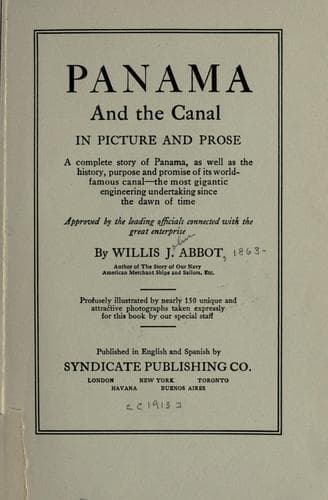
Panama and the Canal in Picture and ProseAbbot, Willis J. (Willis John)
History
Panama and the Canal in Picture and Prose
Abbot, Willis J. (Willis John)
Panama Canal (Panama) -- History
Let us consider the situation toward the midsummer of 1903. In
Washington was the Roosevelt administration keenly eager to have the
canal work begun as a great deed to display to the nation in the coming
presidential campaign. In New York was Mr. William Nelson Cromwell,
representing the French company and quite as keen for action which would
enable him to sell the United States $40,000,000 worth of French
machinery and uncompleted canal. At Bogotá was the Colombian legislature
talking the Hay-Herrara treaty to death and giving every indication of a
purpose of killing it. Spanning the Isthmus was the all important
railroad which was part of the property the French so greatly desired to
sell. And at Panama and Colon were groups of influential men, high
financiers in a small way--a leader among them was the owner of the
Panama lottery--exceedingly anxious to have the handling of that
$10,000,000 which the United States would pay for a franchise, and quite
desirous to have the country tributary to those two towns suddenly
populated by 40,000 to 50,000 canal workmen, all drawing money from the
United States and spending it there.
[Illustration: COPYRIGHT, 1913, BY F. E. WRIGHT
ANCON HILL FROM HARBOR OF PANAMA
The town nestles under the northeast side of the hill which is
precipitous and cuts of the sun’s rays early in the afternoon. From the
crest the most beautiful view in Panama may be enjoyed.]
What happened was inevitable. Under the conditions existing only two
things could have prevented the successful revolution which did
occur--the quick ratification of a satisfactory treaty between the
United States and Colombia, or an observance by the United States of the
spirit as well as the letter of neutrality in the inevitable revolution.
Neither of these things happened. The Congress at Bogotá failed to
ratify the treaty. In Panama and Colon the revolutionary Junta
conspired, and sent emissaries to Washington to sound the government
there on its attitude in case of a revolution. To their aid came Mr.
Cromwell and M. Bunau-Varilla, a highly distinguished French engineer
also interested in the plight of his countrymen. Dr. Amador was chosen
to sound the then Secretary of State John Hay. He was told, according to
trustworthy reports, that while the United States guaranteed Colombia
against foreign aggression it did not bind itself to protect the
sovereignty of that state against domestic revolution. In the event of
such an uprising all it was bound to do was to see that traffic over the
railroad was unimpeded. This sounded and still sounds fair enough, but
there were minds among the revolutionists to see that this policy opened
the way for a successful revolution at last.
Public-domain text, read in full here on John Shaqi.
Reviews
Reviews
No reviews yet
Be the first to share your thoughts on this work.
Elsewhere in the archive
Join the Discussion
Join the discussion
Sign in to leave a comment or review.
Sign InorCreate an account