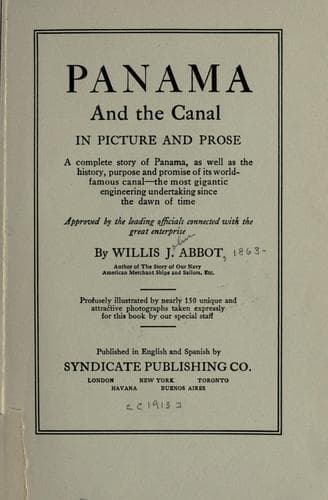
Panama and the Canal in Picture and ProseAbbot, Willis J. (Willis John)
History
Panama and the Canal in Picture and Prose
Abbot, Willis J. (Willis John)
Panama Canal (Panama) -- History
For this is the way in which the policy worked when put to the test--and
indeed some of the incidents indicate that the Roosevelt administration
went somewhat beyond the letter of the rule Secretary Hay had laid down.
Our government knew before the revolutionary blow was struck that it
was imminent. It is said indeed that when the revolutionists suggested
September 22nd as the date for the spontaneous uprising of the people
the Secretary sagaciously suggested that the Congress of Colombia would
not then have adjourned and that it might seem irregular to base a
revolution on the omission of the legislature to act when it was still
in session and could correct that omission. For this, or some other
reason, the revolution was postponed until November 5th. The Colombian
minister at Washington kept his government advised of the suspicious
activity there of the agents of the Junta and warmly advised the heavy
reënforcement of the garrison at Panama. But his home government was
slow to follow his advice. When it did move it was checked by the French
managers of the railroad.
[Illustration: _Photo by Underwood & Underwood_
THE TWO PRESIDENTS; ROOSEVELT AND AMADOR]
Colombia’s only considerable seaport on the Pacific is Buenaventura and
at this point troops were collected to reënforce Panama. Two Colombian
gunboats in harbor at Panama were ordered to go after the troops. Coal
was needed for the voyage. The only source of coal supplies on the
Isthmus was the Panama Railroad which had long made a practice of
selling the fuel to all comers. But to the request of the Colombian navy
for coal at this time the railroad agent, evidently primed for the
occasion, put in a reluctant negative. All his coal was at Colon, and
the pressure of commercial business was so great that he could not move
it across the Isthmus in season to be of use to the gunboats. So those
troops stayed at Buenaventura and the Junta at Panama went on with its
plotting.
Now Colombia tried another plan to reënforce its Panama garrison--or to
replace it, for by this time the troops that had been there were won
over to the smoldering conspiracy. About four hundred soldiers were sent
down by the Gulf and landed at Colon. That they were landed at all seems
like a slight error in carrying out the Roosevelt policy, for in the
harbor of Colon lay the United States cruiser “Nashville” and gunboat
“Dixie” whose commanders had this despatch from the Secretary of the
Navy:
“Maintain free and uninterrupted transit. If interruption is
threatened by armed force occupy line of railroad. Prevent landing of
any armed force with hostile intent either government or insurgent,
either at Colon, Porto Bello or other points.”
Public-domain text, read in full here on John Shaqi.
Reviews
Reviews
No reviews yet
Be the first to share your thoughts on this work.
Elsewhere in the archive
Join the Discussion
Join the discussion
Sign in to leave a comment or review.
Sign InorCreate an account