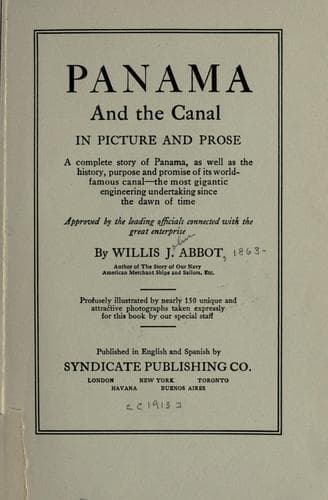
Panama and the Canal in Picture and ProseAbbot, Willis J. (Willis John)
History
Panama and the Canal in Picture and Prose
Abbot, Willis J. (Willis John)
Panama Canal (Panama) -- History
Now there are some curious features about this despatch. On November
2nd, its date, there was no insurrection, therefore no insurgents. If
the administration intended to take official cognizance of the
activities of the Junta it must have known that the conspirators had no
ships and could not therefore plan landing any forces. The order then
was plainly designed to prevent Colombia from landing troops in its own
territory--a most extraordinary policy to adopt toward a friendly
nation. It was furthermore an order equivalent to assuring the success
of the foreshadowed revolution, for as there was no way except by sea
for Colombia to send troops to put down the insurgents, it was evident
that for the United States by its superior force to close the sea
against her was to give Panama over to the revolutionists.
[Illustration: CHOLO CHIEF AND HIS THIRD WIFE
The Chief is said to have poisoned her two predecessors]
However 400 troops were landed on the 3rd of November. The commander of
the “Nashville” probably thought his orders only operative in case of an
outbreak of insurrection and thus far there had been none. It became
time for the railroad company to declare its second check--which in this
case was checkmate. When the two generals in command of the Colombian
forces ordered special trains to transport their men to Panama the agent
blandly asked for prepayment of the fares--something above $2000. The
generals were embarrassed. They had no funds. It was of course the
business of the road, under its charter from Colombia, to transport the
troops on demand, and it was the part of the generals to use their
troops to compel it to do so. Taking the matter under advisement they
went alone across to Panama to investigate the situation. There they
were met by Gen. Huertas, in command of the garrison who first gave them
a good dinner and then put them under arrest informing them that Panama
had revolted, was now an independent republic, and that he was part of
the new régime. There was no more to it in Panama. The two generals
submitted gracefully. The Junta arrested all the Colombian officials in
Panama, who thereupon readily took oath of fealty to the new government.
A street mob, mainly boys, paraded cheering for Panama Libre. The Panama
flag sprang into being, and the revolution was complete.
[Illustration: _Photo by Prof. Lutz_
NATIVE HOUSE AND GROUP AT PUERTA PINAS]
[Illustration: WHAT THEY CALL A STREET IN TOBAGA]
Out in the harbor lay three Colombian gunboats. Two swiftly displayed
Panama flags which by singular good fortune were in their lockers. The
third with a fine show of loyalty fired two shells over the insurgent
city, one of which, bursting, slew an innocent Chinaman smoking opium in
his bunk. The city responded with an ineffective shot or two from the
seawall and the sole defender of the sovereignty of Colombia pulled down
its flag.
Public-domain text, read in full here on John Shaqi.
Reviews
Reviews
No reviews yet
Be the first to share your thoughts on this work.
Elsewhere in the archive
Join the Discussion
Join the discussion
Sign in to leave a comment or review.
Sign InorCreate an account