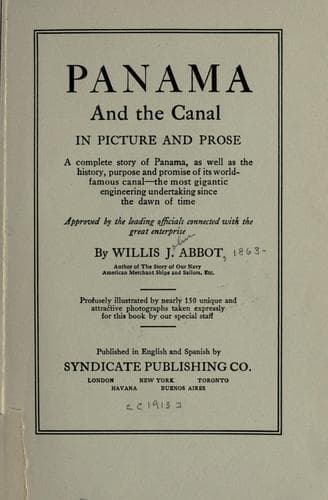
Panama and the Canal in Picture and ProseAbbot, Willis J. (Willis John)
History
Panama and the Canal in Picture and Prose
Abbot, Willis J. (Willis John)
Panama Canal (Panama) -- History
In accordance with the Spooner act President Roosevelt on March 8, 1904,
appointed the first Isthmian Canal Commission with the following
personnel:
Admiral John G. Walker, U. S. N., _Chairman_,
Major General George W. Davis, U. S. A.,
William Barclay Parsons,
William H. Burr,
Benjamin M. Harrod,
Carl Ewald Gunsky,
Frank J. Hecker.
[Illustration: _Photo by Underwood & Underwood_
TUNNEL FOR THE OBISPO DIVERSION CANAL]
In 1913 when the canal approached completion not one of these gentlemen
was associated with it. Death had carried away Admiral Walker, but
official mortality had ended the canal-digging careers of the others.
Indeed under the rule of President Roosevelt the tenure of office of
Isthmian Commissioners was exceedingly slender and the whole commission
as originally designed was finally abolished being replaced by one made
up, with one exception, of officers of the army and navy. The first
commission visited the Isthmus, stayed precisely 24 days, ordered some
new surveys and returned to the United States. The most important fact
about its visit was that it was accompanied to the scene of work by an
army surgeon, one Dr. W. C. Gorgas, who had been engaged in cleaning up
Havana. Major Gorgas, to give him his army title, was not at this time a
member of the Commission but had been appointed Chief Sanitary Officer.
I shall have much to say of his work in a later chapter; as for that
matter Fame will have much to say of him in later ages. Col. Goethals,
who will share that pinnacle was not at this time associated with the
canal work. Coincidently with the Commission’s visit the President
appointed as chief engineer, John F. Wallace, at the moment general
manager of the Illinois Central Railroad. His salary was fixed at
$25,000 a year.
In telling the story of the digging of the Panama Canal we shall find
throughout that the engineer outshines the Commission; the executive
rather than the legislative is the ruling force. The story therefore
groups itself into three chapters of very unequal length--namely the
administrations as chief engineers of John F. Wallace, from June 1,
1904, to June 28, 1905; John F. Stevens, June 30, 1905, to April 1,
1907, and Col. George W. Goethals from April 1, 1907, to the time of
publication of this book and doubtless for a very considerable period
thereafter.
Each of these officials encountered new problems, serious obstacles,
heartbreaking delays and disappointments. Two broke down under the
strain; doubtless the one who took up the work last profited by both the
errors and the successes of his predecessors. It is but human nature to
give the highest applause to him who is in at the death, to immortalize
the soldier who plants the flag on the citadel, forgetting him who fell
making a breach in the outer breastworks and thereby made possible the
ultimate triumph.
[Illustration: _Photo by Underwood & Underwood_
THE TWO COLONELS
Public-domain text, read in full here on John Shaqi.
Reviews
Reviews
No reviews yet
Be the first to share your thoughts on this work.
Elsewhere in the archive
Join the Discussion
Join the discussion
Sign in to leave a comment or review.
Sign InorCreate an account