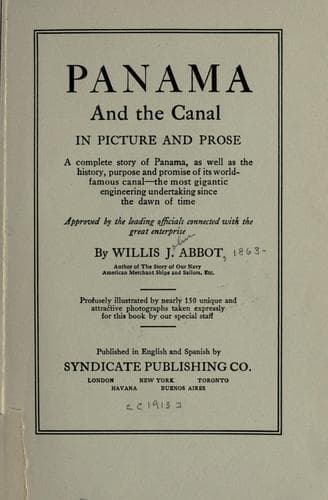
Panama and the Canal in Picture and ProseAbbot, Willis J. (Willis John)
History
Panama and the Canal in Picture and Prose
Abbot, Willis J. (Willis John)
Panama Canal (Panama) -- History
W. C. Gorgas and George W. Goethals, whose combined work gave the canal
to the world.]
Wallace at the very outset had to overcome one grim and unrelenting
enemy which was largely subdued before his successors took up the work.
Yellow fever and malaria ravaged the Isthmus, as they had done from time
immemorial, and although Sanitary Officer Gorgas was there with
knowledge of how to put that foe to rout the campaign was yet to be
begun. They say that Wallace had a lurking dread that before he could
finish the canal the canal would finish him, and indeed he had sound
reasons for that fear. He found the headquarters of the chief engineer
in the building on Avenida Centrale now occupied by the United States
legation, but prior to his time tenanted by the French Director-General.
The streets of the town were unpaved, ankle deep in foul mire in the
rainy season, and covered with germ-laden dust when dry. There being no
sewers the townsfolk with airy indifference to public health emptied
their slops from the second-story windows feeling they had made
sufficient concession to the general welfare if they warned passersby
before tilting the bucket. Yellow fever was always present in isolated
cases, and by the time Wallace had been on the job a few months it
became epidemic, and among the victims was the wife of his secretary.
[Illustration: A WALK AT ANCON]
[Illustration]
[Illustration: IN THE HOSPITAL GROUNDS]
However, the new chief engineer tackled the job with energy. There was
quite enough to enlist his best energies. It must be remembered that at
this date the fundamental problem of a sea level _vs._ a lock canal had
not been determined--was not definitely settled indeed until 1906.
Accordingly Engineer Wallace’s first work was getting ready to work. He
found 746 men tickling the surface of Culebra Cut with hand tools; the
old French houses, all there were for the new force had been seized upon
by natives or overrun by the jungle; while the French had left great
quantities of serviceable machinery it had been abandoned in the open
and required careful overhauling before being fit for use; the railroad
was inadequate in track mileage and in equipment. Above all the labor
problem was yet to be successfully solved. In his one year’s service
Wallace repaired 357 French houses and built 48 new ones, but the task
of housing the employees was still far from completed. Men swarmed over
the old French machinery, cutting away the jungle, dousing the metal
with kerosene and cleaning off the rust. Floating dredges were set to
work in the channel at the Atlantic end--which incidentally has been
abandoned in the completed plans for the canal though it was used in
preliminary construction. The railroad was reëquipped and extended and
the foundation laid for the thoroughly up-to-date road it now is.
Meanwhile the surveying parties were busy in the field collecting the
data from which after a prolonged period of discussion, the vexed
Public-domain text, read in full here on John Shaqi.
Reviews
Reviews
No reviews yet
Be the first to share your thoughts on this work.
Elsewhere in the archive
Join the Discussion
Join the discussion
Sign in to leave a comment or review.
Sign InorCreate an account