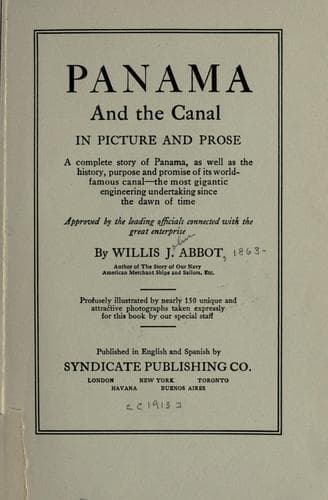
Panama and the Canal in Picture and ProseAbbot, Willis J. (Willis John)
History
Panama and the Canal in Picture and Prose
Abbot, Willis J. (Willis John)
Panama Canal (Panama) -- History
question of the type of canal, should be determined.
Two factors in the situation made Wallace’s job the hardest. The
Commission made its headquarters in Washington, 2000 miles or a week’s
journey away from the job, and the American people, eager for action,
were making the air resound with cries of “make the dirt fly!” In a
sense Wallace’s position was not unlike that of Gen. McClellan in the
opening months of the Civil War when the slogan of the northern press
was “On to Richmond,” and no thought was given to the obstacles in the
path, or the wisdom of preparing fully for the campaign before it was
begun. There are many who hold today that if Wallace had been deaf to
those who wanted to see the dirt fly, had taken the men off the work of
excavation until the type of canal had been determined and all necessary
housing and sanitation work had been completed, the results attained
would have been better, and the strain which broke down this really
capable engineer would have been averted.
[Illustration: _Photo by Underwood & Underwood_
FRENCH COTTAGES ON THE WATER FRONT, CRISTOBAL]
Red tape immeasurable wound about the Chief Engineer and all his
assistants. Requisitions had to go to the Commission for approval and
the Commission clung to Washington tenaciously, as all federal
commissions do wherever the work they are commissioned to perform may be
situated. During the Civil War days a story was current of a Major being
examined for promotion to a colonelcy.
“Now, Major,” asked an examiner, “we will consider, if you please, the
case of a regiment just ordered into battle. What is the usual position
of the colonel in such a case?”
“On Pennsylvania Avenue, about Willard’s Hotel,” responded the Major
bravely and truthfully.
The officers who directed Wallace’s fighting force clung to Pennsylvania
Avenue and its asphalt rather than abide with Avenidà Centrale and its
mud. So too did succeeding commissions until Theodore Roosevelt, who had
a personal penchant for being on the firing line, ordered that all
members of the Commission should reside on the Isthmus. At that he had
trouble enforcing the order except with the Army and Navy officers who
made up five-sevenths of the Commission.
Public-domain text, read in full here on John Shaqi.
Reviews
Reviews
No reviews yet
Be the first to share your thoughts on this work.
Elsewhere in the archive
Join the Discussion
Join the discussion
Sign in to leave a comment or review.
Sign InorCreate an account