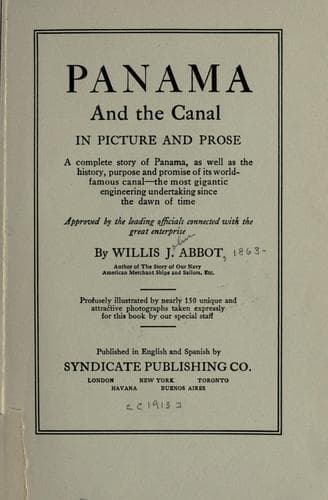
Panama and the Canal in Picture and ProseAbbot, Willis J. (Willis John)
History
Panama and the Canal in Picture and Prose
Abbot, Willis J. (Willis John)
Panama Canal (Panama) -- History
How great was the delay caused by red tape and absentee authorities
cannot be estimated. When requisitions for supplies reached Washington
the regulations required that bids be advertised for. I rather discredit
the current story that when a young Panamanian arrived at Ancon Hospital
and the mother proved unable to furnish him with food, the doctor in
charge was officially notified that if he bought a nursing bottle
without advertising thirty days for bids he must do so at his own
expense. That story seems too strikingly illustrative of red-tape to be
true. But it is true that after Col. Gorgas had worked out his plans
for furnishing running water to Panama, and doing away with the cisterns
and great jars in which the residents stored water and bred mosquitoes,
it took nine months to get the iron pipes, ordinary ones at that, to
Panama. Meanwhile street paving and sewerage were held up and when
Wallace wired the Commission to hurry he was told to be less extravagant
in his use of the cable.
[Illustration: PAY DAY FOR THE BLACK LABOR]
No man suffered more from this sort of official delay and stupidity than
did Col. Gorgas. If any man was fighting for life it was he--not for his
own life but that of the thousands who were working, or yet to work on
the canal. Yet when he called for wire netting to screen out the
malarial mosquitos he was rebuked by the Commission as if he were asking
it merely to contribute to the luxury of the employees. The amount of
ingenuity expended by the Commission in suggesting ways in which wire
netting might be saved would be admirable as indicative of a desire to
guard the public purse, except for the fact that in saving netting they
were wasting human lives. The same policy was pursued when appeals came
in for additional equipment for the hospitals, for new machinery, for
wider authority. Whenever anything was to be done on the canal line the
first word from Washington was always criticism--the policy instantly
applied was delay.
Allowing for the disadvantages under which he labored Mr. Wallace
achieved great results in his year of service on the Isthmus. But his
connection with the canal was ended in a way about which must ever hang
some element of mystery. He complained bitterly, persistently and justly
about the conditions in which he was compelled to work and found in
President Roosevelt a sympathetic and a reasonable auditor. Indeed,
moved by the Chief Engineer’s appeals, the President endeavored to
secure from Congress authority to substitute a Commission of three for
the unwieldy body of seven with which Wallace found it so hard to make
headway. Failing in this the President characteristically enough did by
indirection what Congress would not permit him to do directly. He
demanded and received the resignations of all the original
commissioners, and appointed a new board with the following members:
Theodore P. Shonts, _Chairman_,
Charles E. Magoon, _Governor of the Canal Zone_,
Public-domain text, read in full here on John Shaqi.
Reviews
Reviews
No reviews yet
Be the first to share your thoughts on this work.
Elsewhere in the archive
Join the Discussion
Join the discussion
Sign in to leave a comment or review.
Sign InorCreate an account