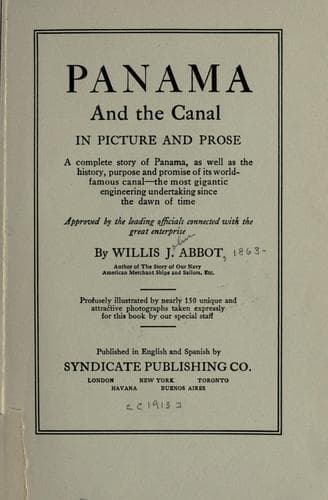
Panama and the Canal in Picture and ProseAbbot, Willis J. (Willis John)
History
Panama and the Canal in Picture and Prose
Abbot, Willis J. (Willis John)
Panama Canal (Panama) -- History
John F. Wallace, _Chief Engineer_,
Mordecai T. Endicott,
Peter C. Hains,
Oswald H. Ernst,
Benjamin M. Harrod.
As in the case of the earlier commissioners none of these remained to
see the work to a conclusion.
This commission, though similar in form, was vastly different in fact
from its predecessor. The President in appointing it had directed that
its first three members should constitute an executive committee, and
that two of these, Gov. Magoon and Engineer Wallace, should reside
continuously on the Zone. To further concentrate power in Mr. Wallace’s
hands he was made Vice-President of the Panama Railroad. The President
thus secured practically all he had asked of Congress, for the executive
committee of three was as powerful as the smaller commission which
Congress had refused him. In all this organization Mr. Wallace had been
consulted at every step. He stayed for two months in Washington while
the changes were in progress and expressed his entire approval of them.
It was therefore with the utmost amazement that the President received
from him, shortly after his return to the Isthmus, a cable requesting a
new conference and hinting at his resignation.
[Illustration: _Photo by Underwood & Underwood_
IN WALLACE’S TIME
Sanitation work in Panama City]
At the moment that cable message was sent Panama was shuddering in the
grasp of the last yellow fever epidemic that has devastated that
territory. Perhaps had Col. Gorgas secured his wire netting earlier, or
Wallace’s appeals for water pipes met with prompter attention it might
have been averted. But in that May and June of 1905 the fever ravaged
the town and the work camps almost as it had in the days of the French.
There had been, as already noted, some scattered cases of yellow fever
in the Zone when the Americans took hold, but they were too few and too
widely separated to cause any general panic. The sanitary authorities
however noted with apprehension that they did not decrease, and that a
very considerable proportion were fatal. It was about this time that the
Commission was snubbing Col. Gorgas because of his insatiable demands
for wire screening. In April there were seven cases among the employees
in the Commission’s headquarters in Panama. Three died and among the 300
other men employed there panic spread rapidly. Nobody cared about jobs
any longer. From all parts of the Zone white-faced men flocked to the
steamship offices to secure passage home. Stories about the ravages of
the disease among the French became current, and the men at work
shuddered as they passed the little French cemeteries so plentifully
scattered along the Zone.
[Illustration: COPYRIGHT, 1913, BY F. E. WRIGHT
THE WASHING PLACE AT TABOGA
Taboga, site of the Commission sanitarium, is the most picturesque point
readily accessible from Panama City. The laundry place is the gathering
point for the women of the village.]
Public-domain text, read in full here on John Shaqi.
Reviews
Reviews
No reviews yet
Be the first to share your thoughts on this work.
Elsewhere in the archive
Join the Discussion
Join the discussion
Sign in to leave a comment or review.
Sign InorCreate an account