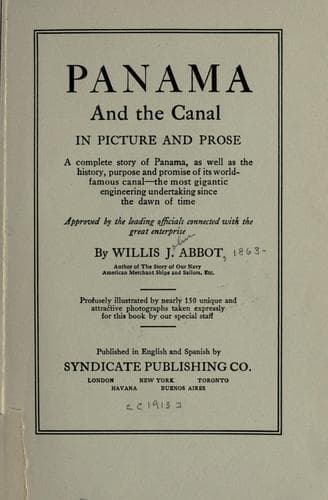
Panama and the Canal in Picture and ProseAbbot, Willis J. (Willis John)
History
Panama and the Canal in Picture and Prose
Abbot, Willis J. (Willis John)
Panama Canal (Panama) -- History
The sanitary forces wheeled out into the open and went into the fight.
Every house in Panama and Colon was fumigated, against the bitter
protests of many of the householders who would rather face yellow fever
then the cleansing process, and who did not believe much in these
scientific ideas of the “gringoes” anyway. An army of inspectors made
house to house canvasses of the towns and removed, sometimes by force,
all suspected victims to the isolation hospitals. The malignant
mosquitoes, couriers of the infection, were pursued patiently by
regiments of men who slew all that were detected and deluged the
breeding places with larvacide. The war of science upon sickness soon
began to tell. June showed the high-water mark of pestilence with
sixty-two cases, and six deaths. From that point it declined until in
December the last case was registered. Since then there has been no case
of yellow fever originating on the Isthmus, and the few that have been
brought there have been so segregated that no infection has resulted.
[Illustration: THE FUMIGATION BRIGADE
When the members of this command finished with a district in Panama the
mosquito was done for]
It was, however, when the epidemic was at its height that Mr. Wallace
returned from Washington to the Isthmus. Almost immediately he cabled
asking to be recalled and the President, with a premonition of impending
trouble, so directed. On reaching New York he met the then Secretary of
War, afterwards President, William Howard Taft, to whom he expressed
dissatisfaction with the situation and asked to be relieved at the
earliest possible moment. Secretary Taft declined to consider his
further association with the canal, for a moment, demanded that his
resignation take effect at once and reproached him for abandoning the
work in words that stung, and which when reiterated in a letter and
published the next day put the retiring engineer in a most unenviable
position. From this position he never extricated himself. Perhaps the
fear of the fever, of which he thought he himself had a slight attack,
shook his nerve. Perhaps, as the uncharitable thought and the Secretary
flatly charged, a better position had offered itself just as he had
become morally bound to finish the canal work. Or perhaps he concluded
in the time he had for cool reflection on the voyage to Panama that the
remedies offered for the red tape, divided authority and delay that had
so handicapped him were inadequate. His communication to the press at
the time was unconvincing. The fairest course to pursue in the matter is
to accept Mr. Wallace’s own statement made to a congressional
investigating committee nearly a year later, in answer to a question as
to the cause of his resignation:
[Illustration: TYPICAL SCREENED HOUSES]
Public-domain text, read in full here on John Shaqi.
Reviews
Reviews
No reviews yet
Be the first to share your thoughts on this work.
Elsewhere in the archive
Join the Discussion
Join the discussion
Sign in to leave a comment or review.
Sign InorCreate an account