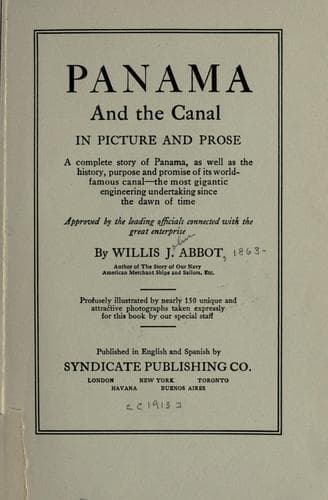
Panama and the Canal in Picture and ProseAbbot, Willis J. (Willis John)
History
Panama and the Canal in Picture and Prose
Abbot, Willis J. (Willis John)
Panama Canal (Panama) -- History
“The masonry of the Gatun locks was largely placed by cableways, having
a span of 800 feet, covering the entire space to be occupied by the
locks. The stone and sand for the concrete were obtained, respectively,
20 and 40 miles down the Caribbean coast, and were brought in barges up
the old French Canal as closely as possible to the lock site, and were
unloaded by cableways into large stock piles near the bank. The
material, however, was still 3,500 feet away and 60 feet below the
center of lock construction. This situation caused the adoption of a
central mixing plant near the central portion of the locks, consisting
of eight 2-yard mixers. An automatic, electric, loop-line railroad, each
car carrying the material for a batch of concrete, was installed,
passing under the cement shed, under the sand and stone piles; and over
the mixers. The mixed concrete was delivered to the cableways requiring
it by an electric line, the flat cars of which were handled by electric
locomotives. Steel forms were used in constructing the walls of the
locks”.
A vital feature of the locks is, of course, getting the water into and
out of them, and the method of operating the gigantic gates. The former
is simple enough of explanation, though the _modus operandi_ will be
entirely concealed when the locks are in operation. Through each of the
side walls, and through the center walls which divide the pairs of
locks, runs a tunnel 18 feet in diameter. To put it more graphically a
tunnel large enough to take a mogul locomotive of the highest type. From
this main tunnel smaller ones branch off to the floors of the locks that
are to be served, and these smaller chutes are big enough for the
passage of a farmer’s wagon with a span of horses. These smaller chutes
extend under the floor of the lock and connect with it by valved
openings, the valves being operated by electricity. There is no pumping
of the water. Each lock is filled by the natural descent of the water
from the lock above or from the lake. By the use of the great culvert in
the central wall the water can be transferred from a lock on the west
side of the flight to one on the east, or vice versa. Though it hardly
seems necessary, every possible device for the conservation of the water
supply has been provided.
We will suppose a vessel from the Atlantic reaches Gatun and begins to
climb to the lake above. The electric locomotives tow her into the first
lock, which is filled just to the level of the Canal. The great gates
close behind her.
[Illustration: THE HEAVY WHEEL SHOWN IS THE “BULL WHEEL”
By its revolution it thrusts or withdraws the arm at the right which
moves the gate]
Public-domain text, read in full here on John Shaqi.
Reviews
Reviews
No reviews yet
Be the first to share your thoughts on this work.
Elsewhere in the archive
Join the Discussion
Join the discussion
Sign in to leave a comment or review.
Sign InorCreate an account