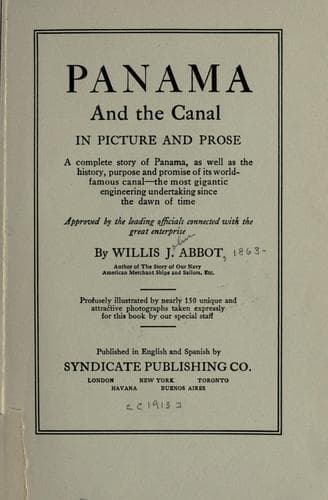
Panama and the Canal in Picture and ProseAbbot, Willis J. (Willis John)
History
Panama and the Canal in Picture and Prose
Abbot, Willis J. (Willis John)
Panama Canal (Panama) -- History
How do they close? What unseen power forces those huge gates of steel,
shut against the dogged resistance of the water? They are 7 feet thick,
65 feet long and from 47 to 82 feet high. They weigh from 390 to 730
tons each. Add to this weight the resistance of the water and it becomes
evident that large power is needed to operate them. At Gatun in the
passing of a large ship through the locks, it will be necessary to lower
four fender chains, operate six pairs of miter gates and force them to
miter, open and close eight pairs of rising stem gate valves for the
main supply culverts, and thirty cylindrical valves. In all, no less
than 98 motors will be set in motion twice during each lockage of a
single ship, and this number may be increased to 143, dependent upon the
previous position of the gates, valves and other devices. Down under the
surface of the lock wall, packed into a little crypt which seems barely
to afford room for its revolving, is a great cogwheel 20 feet in
diameter, revolving slowly and operating a ponderous steel arm which
thrusts out or pulls back the gate as desired. The bull wheel, they call
it, is driven by a 27 horse power motor, while a smaller motor of 7¹⁄₂
horse power locks the gates tight after they are once in position. Two
of these bull wheels, and two each of the motors are needed for each
pair of gates.
[Illustration: THE TANGLED MAZE OF STEEL SKELETONS THAT ARE A LOCK IN
THE MAKING]
The ship then is in the lowest lock, one pair of gates closed tightly
behind her. Another pair confronts her holding back the water in the
lock above, which if filled, will be just 28¹⁄₃ feet above the surface
of that on which she floats. But the water about her is now slowly
rising. Another set of electric motors concealed in the concrete wall
have set in motion the valves in the floor of the lock, and the water is
flowing in from the tunnels, raising the ship and at the same time
lowering the water in the lock above. When the vessel’s keel is higher
than the sill of the lock above the upper gates swing slowly back and
fold in flat with the wall. The ship is now in a chamber 2000 feet long
filled to a level. The locomotives pull her forward a thousand feet or
so. Again great gates close behind her. Again the water rises slowly
about her lifting her with it. The first process is repeated and she
enters the third lock. By the time she has been drawn out into the lake
and the locomotives have cast her off, more than 100 electric motors
with a horse power ranging from 7¹⁄₂ to 50 each will have contributed to
her progress. Altogether over 1000 individual motors will be required
for the different locks. Indeed the whole interior of those massive lock
walls is penetrated by lighted galleries strung with insulated wires
bearing a death-dealing current. Men will be stationed at the various
machinery rooms, but the whole line of machinery can be operated from a
central operating tower on the lock above.
CHAPTER XI
Public-domain text, read in full here on John Shaqi.
Reviews
Reviews
No reviews yet
Be the first to share your thoughts on this work.
Elsewhere in the archive
Join the Discussion
Join the discussion
Sign in to leave a comment or review.
Sign InorCreate an account